State Museum of Egyptian Art, Egyptian art museum in Maxvorstadt, Germany
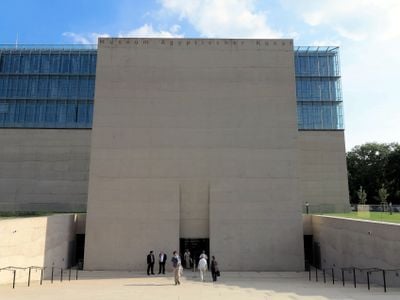
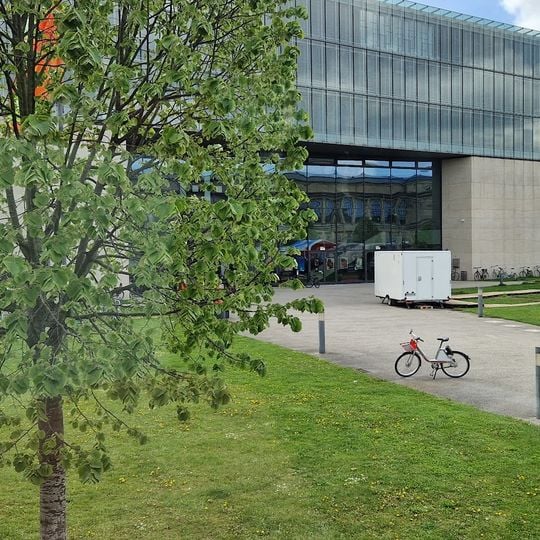
The State Museum of Egyptian Art stands opposite the Alte Pinakothek in Munich's Kunstareal, a concrete and glass building by architect Peter Böhm. Its blank grey central facade carries the metal lettering "Museum Ägyptischer Kunst", flanked by blue glass panels in metal grids; a narrow recess holds the dark entrance. The 13 exhibition rooms lie in the basement, reached by a wide stair leading to a projecting concrete wall.
The collection began with 16th-century Aegyptiaca of Duke Albrecht V and was enlarged by Elector Karl Theodor and King Ludwig I, who bought pieces in Paris in 1816. The Bavarian state collection was founded in 1966 and shown in the Munich Residenz from 1970; it moved to Peter Böhm's new building opposite the Alte Pinakothek in June 2013.
Room texts are painted directly onto the concrete walls, and touchscreen cubes give background on individual pieces. A portable multimedia guide, borrowed in the lobby, covers around 200 exhibits. Since 1984 children have attended summer holiday programmes combining a short tour with handicraft work; a Treasure Hunt and an "Archaeological Backpack" are also offered.
The entrance is at street level, marked by a concrete portal wall modelled on an Egyptian temple pylon; from the lobby a long ramp leads down to the galleries, which all lie underground for conservation reasons. A multimedia guide covering around 200 objects can be borrowed in the lobby. Rooms branch off the lobby for two studios, an auditorium, cloakroom and shop.
The underground architecture was inspired by temples and royal tombs, giving the place a special character. Natural light filters through a sunken courtyard into the exhibition areas, creating unexpected brightness below ground.
The community of curious travelers
AroundUs brings together thousands of curated places, local tips, and hidden gems, enriched daily by 93,630 contributors worldwide.