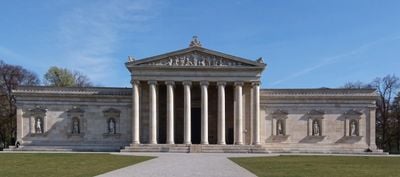
Glyptothek, Greek and Roman sculpture museum in Königsplatz, Germany.
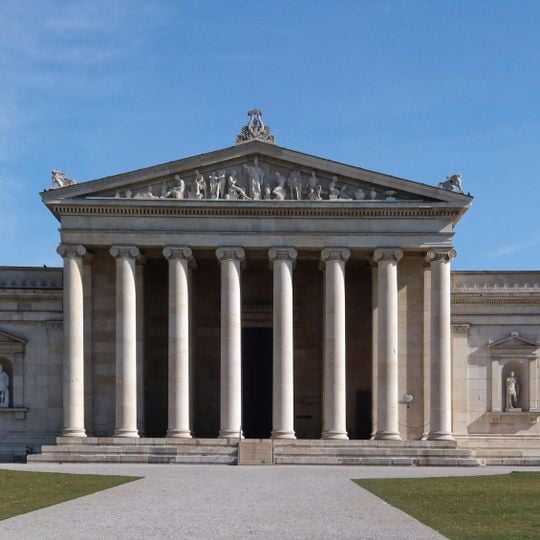
The Glyptothek is Munich's oldest public museum, built 1816–1830 by Leo von Klenze for King Ludwig I's Greek and Roman sculptures. Its Greek Revival facade has a portico of twelve Ionic columns, a pediment group by Johann Martin von Wagner showing Athena, and statue niches in the side wings. Inside, thirteen halls surround a courtyard; the walls are red brick with light plaster, not marble.
The museum was commissioned by King Ludwig I between 1816 and 1830 and designed by architect Leo von Klenze. It was built as part of a plan to make Munich a leading art city.
The name Glyptothek combines the Greek glyphein, "to carve", with theke, "storage place". The collection spans sculpture from about 650 BC to 550 AD, and the Aegina pediment figures acquired in 1813 are displayed as two sets, since archaeologists found two groups of similar sculptures at the site.
The thirteen halls are arranged around an inner courtyard, with the vestibule in the central building rising above them. The entrance portico faces Königsplatz on the north side, and the windows of the halls open onto the courtyard. The building was closed for renovation from October 2018 and reopened on 26 March 2021.
The interior was originally decorated with colorful frescoes and stucco work by Peter von Cornelius and Wilhelm von Kaulbach. These elaborate decorations were damaged during World War II, which changed how visitors experience the artworks compared to the original design.
The community of curious travelers
AroundUs brings together thousands of curated places, local tips, and hidden gems, enriched daily by 93,141 contributors worldwide.