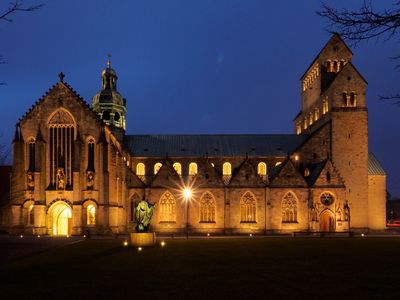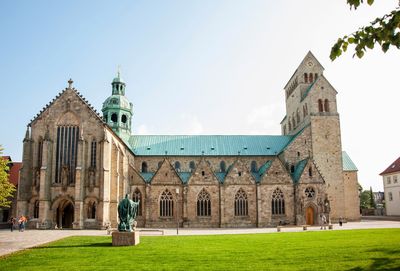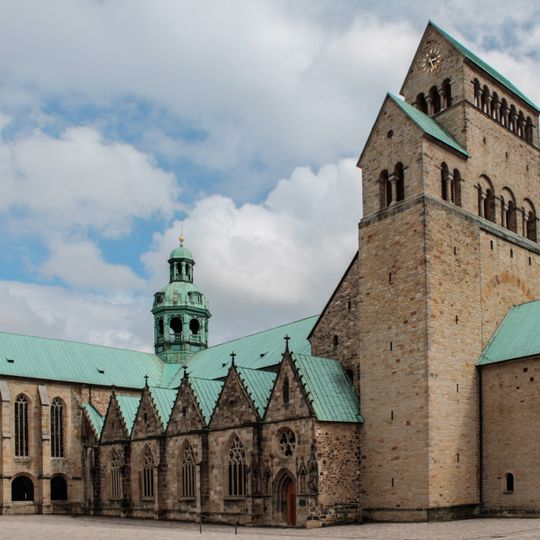
Hildesheimer Dom, Romanesque cathedral in Hildesheim, Germany
Hildesheim Cathedral is a cruciform basilica with a two-story westwork and a baroque crossing tower topped by a green copper dome. Its light beige stone walls mix Romanesque and Gothic parts, including pointed gables with tracery and a tall square clock tower. The 872 core was rebuilt after 1945 using rubble stone, concrete ceilings and a marble floor.
The first cathedral on this site was built in 872 under Bishop Altfrid as a cruciform basilica with a two-storey westwork. After a fire in 1046, Bishop Hezilo rebuilt on the old foundations. The cathedral was almost entirely destroyed in an air raid on 22 March 1945; only the westwork and outer walls survived. Rebuilt between 1950 and 1960, it was reconsecrated on 27 March 1960.
The cathedral has been a gathering place for the faithful for over a thousand years, where people come together to pray and observe religious celebrations. The bronze doors and ornately painted ceiling shape the visual experience that visitors encounter when entering.
The cathedral is open daily and provides wheelchair access throughout the main areas for visitors with mobility needs. Guided tours in multiple languages help people understand the artworks and architectural details more fully.
The cathedral library, housed in the cloister where the cathedral school taught, traces its founding to 815 and is considered the oldest library in Northern Germany. Excavations during the 2010 renovation also uncovered an early 9th-century cemetery west and south of the Marian chapel, including the grave of a young woman buried around 800 with glass beads and a small knife.
The community of curious travelers
AroundUs brings together thousands of curated places, local tips, and hidden gems, enriched daily by 94,533 contributors worldwide.