Hersfeld Abbey, Benedictine monastery in Bad Hersfeld, Germany.
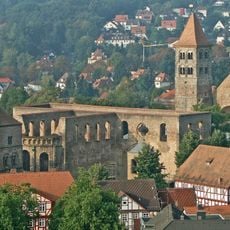
Hersfeld Abbey is a religious monastery in Bad Hersfeld comprising multiple stone structures situated where three rivers—the Geisa, Haune, and Fulda—meet. The ruins of its church remain the largest Romanesque church remains in Europe.
Lullus, Archbishop of Mainz, re-founded the Benedictine monastery at Hersfeld around 769 on the site of an earlier cell of Saint Sturm; Charlemagne raised it to an imperial abbey in 775. The abbey church was rebuilt between 831 and 850, and in 852 Lullus's grave was moved into the new basilica. After the Reformation the abbey passed under Hessian control, and on the death of the last abbot, Joachim Röll, in 1606 it was placed under a lay administrator; the Peace of Westphalia of 1648 turned it into the secular Principality of Hersfeld.
The monastery served as a hub for learning and manuscript work, where monks carefully produced books and recorded historical events. This role made it an important center for knowledge and education across the medieval region.
The ruins are freely accessible, allowing visitors to walk through the old stone structures and understand the scale of the former complex. Comfortable shoes and adequate time are recommended to explore all areas of the site thoroughly.
Each year artists use the ruins as a backdrop for the Bad Hersfeld Festival, an open-air theater hosting performances within the medieval stone walls. This contemporary use of the historic site creates an unusual blend of past and present.
The community of curious travelers
AroundUs brings together thousands of curated places, local tips, and hidden gems, enriched daily by 93,583 contributors worldwide.