Church of Saint Salvator, Gothic church in Münchner Altstadt, Germany
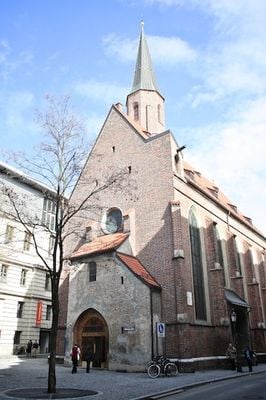
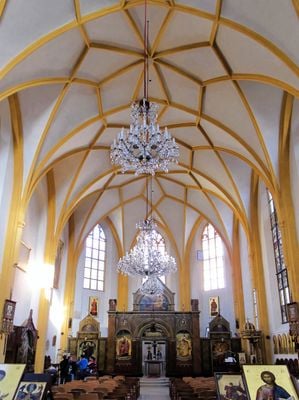
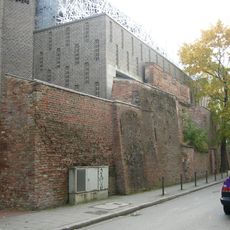
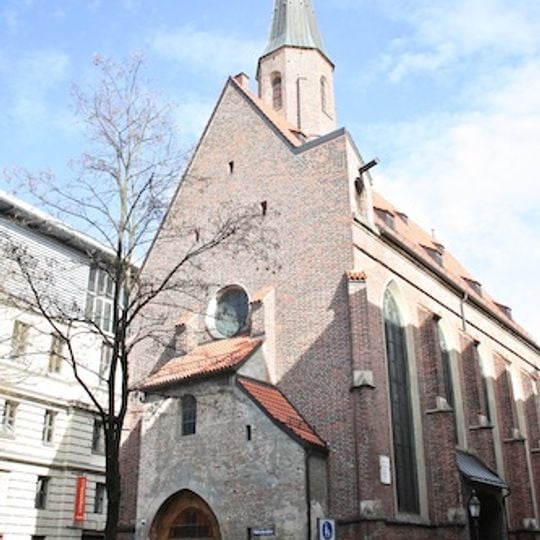
The Church of Saint Salvator is a late Gothic brick church on Salvatorplatz in Munich's Kreuzviertel. Its steep gabled front holds a small round window, and a slender tower with a green spire rises behind it; a lower porch with a red tiled roof shelters the arched wooden entry. Inside, yellow-painted ribs cross a white plaster ceiling above two crystal chandeliers and a dark wooden iconostasis.
St. Salvator was built as the cemetery church of the Frauenkirche after Duke Albrecht IV moved that parish graveyard to the town edge; the shell was finished around April 1493 and the church was consecrated on 15 August 1494, probably by Lukas Rottaler. In 1806 King Max I Joseph gave it to Munich's Lutheran congregation, which could not use it, and in 1829 Leo von Klenze converted it for the Greek Orthodox community.
The church is named for Saint Salvator and serves as an important place for the Greek Orthodox community in Munich. Visitors can see an Ikonostasis displayed inside that shapes the interior and shows how the Gothic space was adapted for Orthodox worship.
Access is from Untere Salvatorgasse in the old town, where the church is easily reached on foot. As an active place of worship, visitors should consider their arrival time and wear respectful clothing to honor the ongoing religious functions.
The church is owned by the Free State of Bavaria, not by the Greek Orthodox community that has used it since 1829. The mathematician Constantin Carathéodory served as church council during the Nazi period. In the 1990s, a box of shattered late Gothic stained glass was found in the gallery and reassembled; four windows were reinstalled in 2000.
The community of curious travelers
AroundUs brings together thousands of curated places, local tips, and hidden gems, enriched daily by 94,014 contributors worldwide.