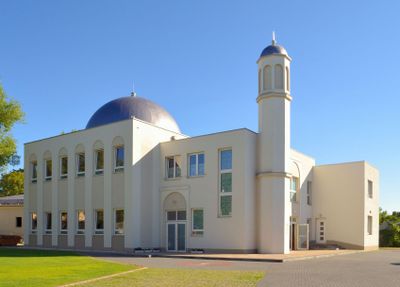
Khadija Mosque, Contemporary mosque in Heinersdorf, Germany.
Khadija Mosque is a two-storey Ahmadiyya mosque on a 4,790-square-metre site in Heinersdorf, with two prayer rooms for 250 women and 250 men. Its dome measures 4.5 metres high and 9 metres across, and the minaret rises 13 metres. The design is attributed to architect Mubashra Ilyas, with construction overseen by the Pakdel office; a public children's playground lies on the grounds.
The Ahmadiyya community first planned a Berlin mosque in the 1920s, when women raised 50,000 rupees for it, but the currency crisis stopped the build and the money went to London's Fazl Mosque. Revived under the 100-Mosques-Plan, the Khadija Mosque's foundation stone was laid on 2 January 2007 by Khalifa Mirza Masroor Ahmad, and it opened on 16 October 2008 as the first mosque in former East Germany.
The mosque is named after Khadija bint Khuwaylid, the first Muslim and first wife of the Prophet Muhammad. Its construction was funded by the women's organisation Lajna Imaillah, and the first Friday sermon was delivered there by Khalifa Mirza Masroor Ahmad on 17 October 2008. Six weeks later around 500 visitors came to the community's first open mosque day.
The mosque stands at the corner of the Heinersdorf district in Pankow, in what was formerly East Berlin. A public children's playground opened on the 4,790-square-metre grounds on 29 June 2009. The community held its first open day six weeks after the opening, drawing around 500 visitors.
The 1920s plan for a first European Ahmadiyya mosque in Berlin failed in Germany's currency crisis; the 50,000 rupees Ahmadi women had raised in three months went instead to London's Fazl Mosque. The Heinersdorf project, financed again by the women's organisation Lajna Imaillah, was realised only under the 100-Mosques-Plan.
The community of curious travelers
AroundUs brings together thousands of curated places, local tips, and hidden gems, enriched daily by 92,784 contributors worldwide.