Alte Brücke, Stone arch bridge in Frankfurt, Germany
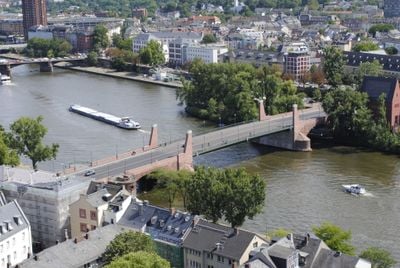
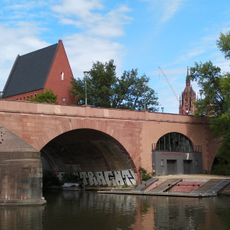
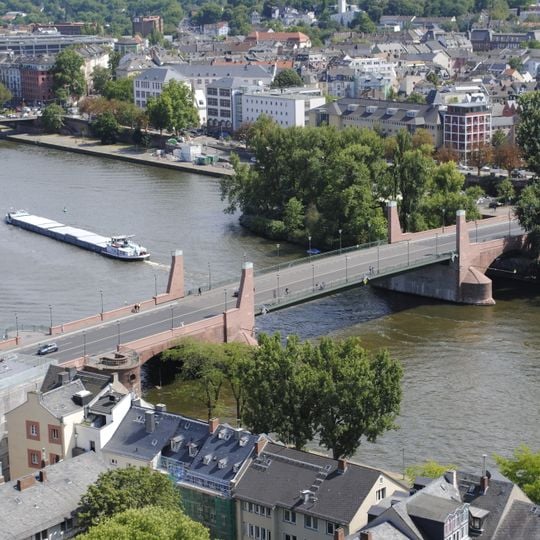
The Alte Brücke is a grey stone arch bridge over the Main, its flat deck edged by a low metal railing. Two tall piers with pointed caps stand at the ends of the visible span and two smaller pointed piers mark the middle, with pale reddish-brown stone set into the ends. A single large round arch rises over the water between the central piers; buildings and trees partly hide the near end.
A wooden bridge stood here by 1035 and was rebuilt after 1192; a stone bridge is first mentioned in 1276, and the crossing appears in records in 1222. The medieval bridge had 13 arches and was demolished in 1914. The current bridge, inaugurated on 15 August 1926 by mayor Ludwig Landmann, lost two vaults to German demolition on 26 March 1945; a steel middle section followed in 1965.
The bridge's landmarks are the Brickegickel, a gilded rooster on a cross, and a statue of Charlemagne, the city's mythical founder. The rooster recalls the legend of a cock that crowed when a bridge builder was wrongly accused of theft. The figure of Charlemagne ties the crossing to the city's founding narrative.
The bridge carries pedestrians and vehicles between the Fahrgasse in the old town and the Brückenstraße in Sachsenhausen. Four portal walls flank the middle section, and the Brickegickel and the Charlemagne statue stand on the bridge itself. Walkers can cross on the sides while traffic passes in the centre.
The Portikus art space, opened in 1987, was rebuilt in 2006 as the Neuer Portikus next to the Alte Brücke, recalling the bridge mill that once stood here. Its name comes from the portico of the 1825 guardhouse on the Paulskirche that housed it until 2002.
The community of curious travelers
AroundUs brings together thousands of curated places, local tips, and hidden gems, enriched daily by 94,244 contributors worldwide.