Schirn Kunsthalle Frankfurt, Art gallery in Frankfurt-Innenstadt I, Germany
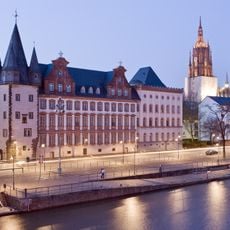
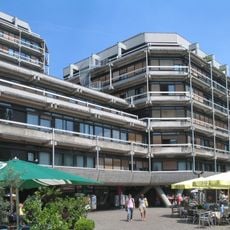
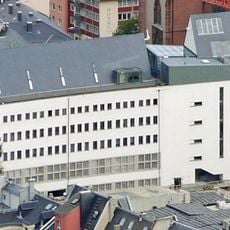
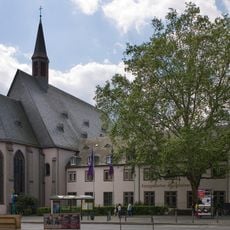
Schirn Kunsthalle Frankfurt is a temporary-exhibition hall in Frankfurt's old town, between the Römer and the cathedral. The Berlin firm BJSS designed it; it opened on 28 February 1986. Its light sandstone volumes interlock: a five-storey, 140-metre-long nave with an open colonnade of square pillars along Bendergasse, a 20-metre-diameter glass-domed rotunda forming the main entrance, and a cube facing Saalgasse. Exhibition space totals about 2,000 square metres.
The site was the densely populated old town centre until its destruction on 22 March 1944. A 1979 national competition, decided under Max Bächer, awarded first prize to the Berlin firm BJSS, and construction began in early 1983. The Schirn opened on 28 February 1986; architect Christoph Mäckler later proposed demolishing parts of it, and Bangert agreed to remove the freestanding "Great Table" in 2012.
The name comes from the Old High German "scranna", via Middle High German "Schranne" and later "Scherne" or "Schirn", meaning an open sales stall. Such stalls stood here until the 19th century, and until the mid-19th century the Frankfurt butchers' guild kept its stalls in the alleys between today's Schirn and the Main. The building has no collection of its own; it shows temporary exhibitions, with past retrospectives of Kandinsky, Chagall, Giacometti, Bill Viola and Yves Klein.
The building runs east to west between Bendergasse and Saalgasse, with its main entrance through the glass-domed rotunda; the eastern end meets the forecourt of the cathedral tower's south portal. A cut passage follows the line of the old Bendergasse through the rotunda, and the Schirn Café occupies the semicircular section north of the alley. The longhouse's ground floor along Bendergasse forms an open colonnade of square pillars, one storey high near the rotunda and two near the cathedral because the lane drops eastward.
The longhouse's ground floors along Bendergasse form an open colonnade of plain square pillars, a deliberate echo of the 150-metre outdoor space of the Uffizi in Florence. Because the lane drops eastward via steps, the arcade is one storey high near the rotunda but two storeys high at the cathedral.
The community of curious travelers
AroundUs brings together thousands of curated places, local tips, and hidden gems, enriched daily by 93,797 contributors worldwide.