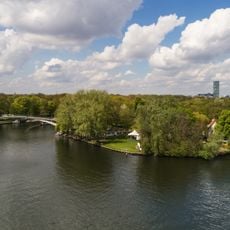
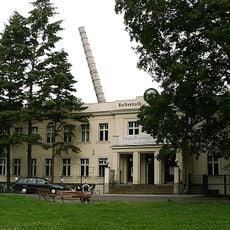
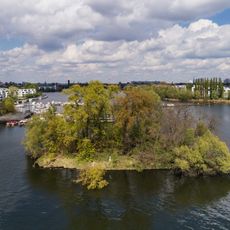
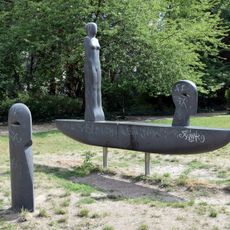
Abteibrücke, Footbridge in Alt-Treptow, Berlin, Germany.
The Abteibrücke is a pedestrian footbridge in Alt-Treptow that spans across the water to connect both banks for walkers. Its design allows larger boats with tall smokestacks to pass underneath without obstruction.
Completed in 1916, the Abteibrücke replaced a ferry to the island and is considered one of Germany's earliest reinforced concrete bridges. Its single wide arch, built without river piers, used concrete-encased cast-iron pipes joined in 2-metre sections; after fracture tests in Berlin and Dresden, an exceptional permit was granted on 23 March 1916. French and Russian prisoners of war helped concrete the arch, and the bridge opened on 1 July 1916.
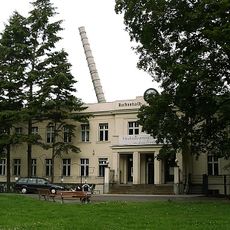
The name refers to the 'Abtei', a Scottish-monastery-ruin-themed excursion restaurant opened on the island after 1896; it burned down in 1914 and its remains were removed. Since 11 June 2005 the bridge has been a 'Bridge of Hearts': blue heart-shaped tiles bearing the names of people honoured for work for children and young people are set into the ramp, handed over by the children's figure Theo Tintenklecks. In 2015, for the tenth anniversary, children and artists decorated 25 original segments of the Berlin Wall with themes for the future.
The bridge is easily accessible on foot and provides a direct crossing for pedestrians and cyclists alike. It is best explored during daylight hours to fully appreciate its structure and surroundings.
During summer 1916, French and Russian prisoners of war worked on the concrete operations before the bridge opened to the public. This story of international cooperation under difficult circumstances is often overlooked by visitors today.
The community of curious travelers
AroundUs brings together thousands of curated places, local tips, and hidden gems, enriched daily by 93,801 contributors worldwide.