Roman theater at Mainz, Roman theater in Mainz-Altstadt, Germany
The Roman theater at Mainz is an archaeological site in the Mainz-Altstadt district where the foundations and vaults of one of the largest ancient theaters north of the Alps are preserved. The remaining structures trace the outline of a semicircular layout with tiered seating and a stage area facing a broad open space.
A theatre was built at Mogontiacum probably in connection with the funeral games for Drusus, whose cenotaph, the Drususstein, stood 340 m away; Suetonius mentions a theatre there in AD 39. The stone structure, 116 m wide with a 42 m stage, held about 10,000 spectators. When the city wall was rebuilt in the mid-4th century using its stone, the theatre lay outside the defences and was quarried away; from the 6th century its vaults served as catacombs, notably for the monastery of St Nikomedes.
The theatre was probably tied to the funeral games and annual ceremonies honouring Drusus, stepson of Augustus, whose cenotaph stood 340 metres away. Representatives of the sixty Gallic communities gathered here for the supplicatio in his honour, and Suetonius mentions a theatre at Mogontiacum in AD 39.
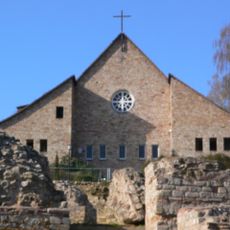
The excavation area lies directly beside the Mainz Römisches Theater station, renamed in December 2006 after the theatre. The visible remains are those uncovered from 1998 onward, so the layout is fragmentary rather than a complete circuit. Excavation has been funded by donations and sponsors and supported by volunteers from Mainz.
Although the theater was among the largest of its kind north of the Alps, it remained buried and forgotten under the city for centuries until construction work in the 20th century brought the structures back to light. Part of the complex still lies hidden beneath modern buildings today.
The community of curious travelers
AroundUs brings together thousands of curated places, local tips, and hidden gems, enriched daily by 93,729 contributors worldwide.