Alter Schlachthof, Cultural center in Soest, Germany
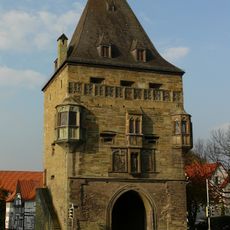
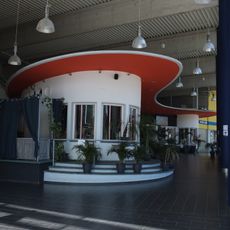
Alter Schlachthof is a cultural and citizens' centre in Soest, housed in the buildings of the former municipal slaughterhouse opposite the Ulricher Tor. The site covers about 8,000 m² with four buildings and roughly 2,500 m² of usable space; covered walkways link them. The silhouette of the old slaughter halls, the chimney and the former cooling tower still shape the townscape and serve as the cultural centre's emblem.
The municipal slaughterhouse opened on 11 April 1881 on land bought from innkeeper W. Keining opposite the Ulricher Tor, with one large hall for all livestock plus stables and administration. A fundamental rebuild to plans by the Berlin specialist architect Frese followed in 1928, when the halls were regrouped west to east and new stables, a gut-cleaning room and a tripe kitchen were added. The 1928 plan served as a model for many slaughterhouses in North Rhine-Westphalia. Operations ceased in 1989.
The site is a Kultur- und Bürgerzentrum, a culture and citizens' centre, in the former municipal slaughterhouse opposite the Ulricher Tor. Its emblem is the silhouette of the old slaughter halls, the chimney and the former cooling tower. Inside, the large steam boilers of the boiler house and the intact blood trough remain part of the working building.
The site lies just outside Soest's wall ring, opposite the Ulricher Tor, on about 8,000 m². Almost all rooms are at ground level and step-free, and roughly 1,000 m² of paths between the four buildings are covered, so visitors move between halls without going outdoors.
The 1928 rebuild plan by Berlin specialist architect Frese was used as a model for many slaughterhouses in North Rhine-Westphalia. The site's steam boilers and blood trough survive inside the present cultural centre.
The community of curious travelers
AroundUs brings together thousands of curated places, local tips, and hidden gems, enriched daily by 94,498 contributors worldwide.