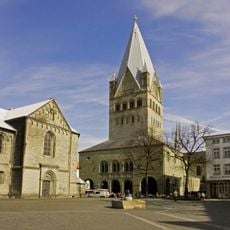
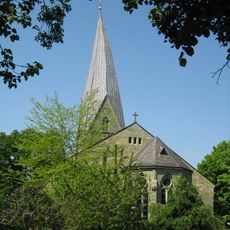
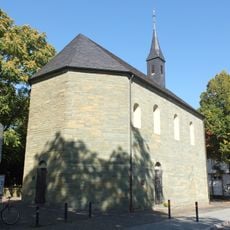
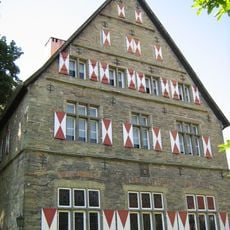
Franziskanerkloster Soest, Franciscan monastery church in Soest, Germany
The Franziskanerkloster Soest is a former friary whose Gothic church, Neu St. Thomae, was begun in 1259. Its four-light tracery windows copy those of Cologne Cathedral, and the 1292 choir has three bays with a 5/8 close and a sacristy on the south side. The four-bay, three-aisle hall nave, consecrated in 1343, has wide pier spacing.
The monastery was founded in 1233 at the request of the Archbishop of Cologne and was the first Franciscan house in Westphalia. It remained active for roughly 600 years until its closure in 1814 following secularization, after which the church passed to Protestant ownership in 1851.
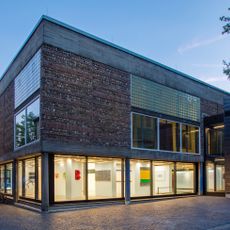
The nickname "Grey Monastery" comes from the colour of the Franciscan habit. The friars, who owned no property under their rule, worked mainly among Soest's poorer classes, caring for the sick, lepers and the dying. After the Reformation of 1531/32 they stayed on to serve the Catholic minority of the city. Since 2025 the church has been run as a cultural church by the Kunstverein Soest.
The monastery is located in Soest's old town with narrow streets and historic buildings that are easy to explore on foot. The church is now open to visitors and serves as a venue for services, concerts, and cultural events.
The church's four-light tracery windows copy those of Cologne Cathedral, a link to the archbishops who promoted the 1259 construction. The convent was dissolved in 1814 with only eight friars left; from 1819 to 1881 the buildings housed Westphalia's teachers' seminary, and from 1892 to 1999 the Protestant preachers' seminary. The monastery archive is now kept in the Münster state archive.
The community of curious travelers
AroundUs brings together thousands of curated places, local tips, and hidden gems, enriched daily by 94,498 contributors worldwide.