Dominikanerkloster Soest, Dominican monastery and church in Soest, Germany.
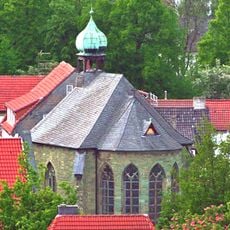
The Dominikanerkloster Soest is a medieval monastic complex centered around a church building in the city of Soest. A preserved wing of the original cloister still stands and connects to a neighboring commercial structure.
Founded between 1228 and 1232, the Dominican convent was recognized as a full convent in 1241, requiring at least twelve friars. It belonged to the Teutonia province and later Saxonia, against the resistance of the Cologne archbishops. After the Reformation was introduced in Soest in 1531/32, the friars cared for the remaining Catholic minority. The community was dissolved in 1814, and the Church of the Holy Cross was demolished in 1820.
The Dominicans were called the "Black Brothers" in Soest, and the pedestrian street Brüderstraße in the northwest of the old town keeps that name alive. The Gasthaus Mönchshof also refers to the friars, though the source notes this link may be unhistorical. The monastery archive is now held at the Staatsarchiv Münster.
The surviving wing stands in the northwest of Soest's old town, in the pedestrian zone around Brüderstraße, and is joined to a neighbouring department store, so it is seen from the outside rather than entered as a monastery. The monastery archive is now held at the State Archive in Münster.
In 1754 about 40 friars lived in the monastery, but by its dissolution only a handful remained. This sharp decline reflects broader shifts in religious life during that period.
The community of curious travelers
AroundUs brings together thousands of curated places, local tips, and hidden gems, enriched daily by 94,457 contributors worldwide.