Old Synagogue, Medieval synagogue in Erfurt, Germany
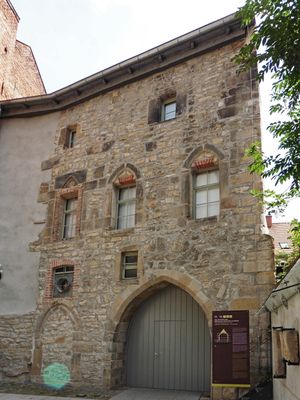
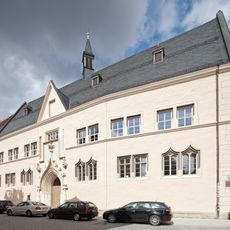
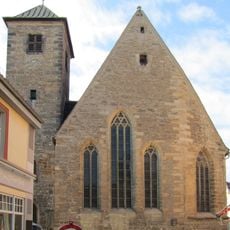
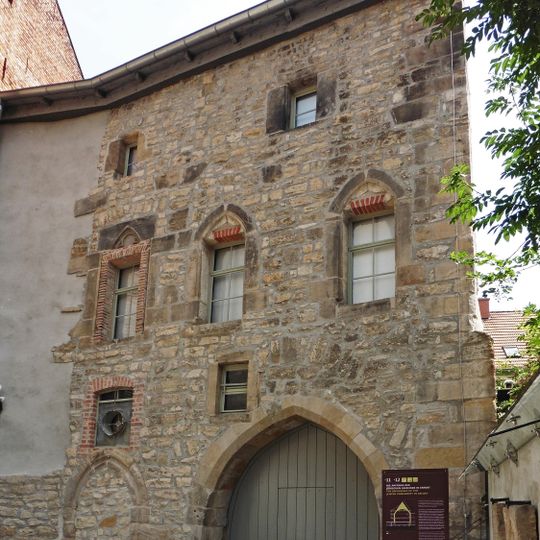
The Old Synagogue is a former synagogue in Erfurt, Thuringia, Germany, set in a courtyard off Michaelisstraße. Its oldest section, part of the west wall, dates to 1094; most of the building was rebuilt around 1270 and enlarged around 1300. The rough stone facade has two pointed-arch windows with brick surrounds and red hood moulds above a pointed-arch doorway with grey wooden double doors.
The oldest section, part of the west wall, was dated by dendrochronology to 1094; a second building phase followed in the 12th century. Around 1270 the synagogue was rebuilt on a larger scale, and around 1300 it was raised by a storey and extended north. After the 1349 massacre of Erfurt's Jews, the building became a warehouse for nearly 500 years, then a ballroom, restaurant and bowling alley; its forgotten history spared it during the Nazi period. The city bought it in 1998 and opened it as a museum on 27 October 2009.
The building is known in Yiddish as Alte Shul and in Hebrew as Beit HaKnesset HaYashan. Since 2009 it has housed facsimiles of the Erfurt Hebrew Manuscripts, including a 12th-century Tosefta, the oldest of only three known copies. Each month the Erfurt Synagogue Evenings bring lectures and music to the former prayer hall.
Access is through guided tours of varying lengths that provide good understanding of the place. Visitors should prepare for uneven floors and narrow stairs, as the medieval building is not fully accessible for mobility issues.
During archaeological excavations in 1998, a hidden treasure of more than 3,000 silver coins and medieval jewelry was discovered here. This find reveals how residents protected their valuables from danger.
The community of curious travelers
AroundUs brings together thousands of curated places, local tips, and hidden gems, enriched daily by 94,032 contributors worldwide.