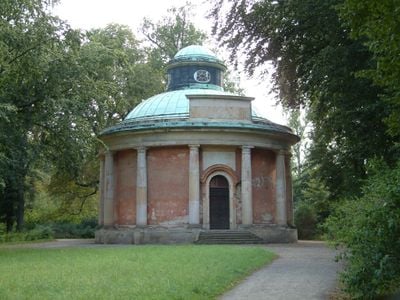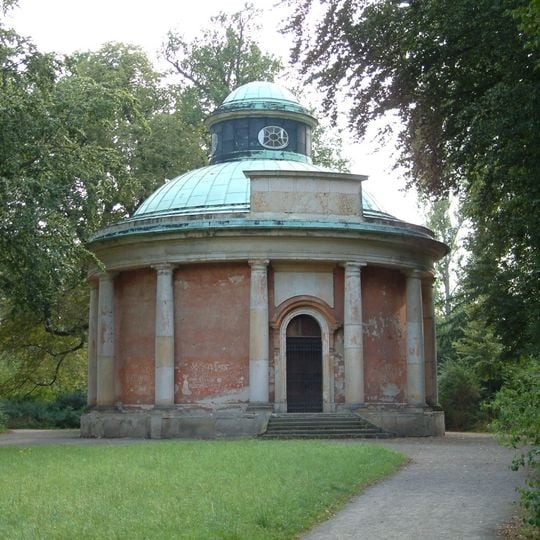
Antique Temple, Neoclassical mausoleum in Sanssouci Park, Potsdam, Germany
The Antique Temple is a closed round temple in the west of Sanssouci Park, built by Carl von Gontard in 1768/69. Its rotunda measures about sixteen metres across, ringed by ten Tuscan columns on a low stepped base; the drum is plastered in faded reddish-orange between pale stone columns, and a shallow green copper roof carries a small pierced cupola. A square annex of 9.4 by 9.4 metres with three windows sits at the rear, and the single entrance is a rounded four-metre door at the top of a staircase.
Frederick the Great had this structure built between 1768 and 1769 under architect Carl von Gontard's direction as a display space for his classical art collection. After his death, the building was repurposed, and from 1921 onward it served as a burial vault for House of Hohenzollern members.
The temple's name comes from its first role: housing Frederick the Great's collection of antique sculpture, coins and gems, which visitors could see after notifying the castellan of the New Palace. Since 1921 it has served as the burial place of members of the House of Hohenzollern, beginning with Empress Auguste Viktoria, and it remains closed to the public.
The temple stands in the western part of Sanssouci Park, north of the Central Alley and near the New Palace, opposite the Temple of Friendship south of the Alley. It is not open to the public, so the exterior, with its stepped base and gravel path, can only be viewed from outside. The Stiftung Preußische Schlösser und Gärten maintains the building.
A rear annex to the temple once housed a special Coin Chamber containing over 9,200 coins and more than 4,300 engraved gems from Frederick's personal collection. These objects reveal how deeply the king was invested in ancient and numismatic treasures.
The community of curious travelers
AroundUs brings together thousands of curated places, local tips, and hidden gems, enriched daily by 92,794 contributors worldwide.