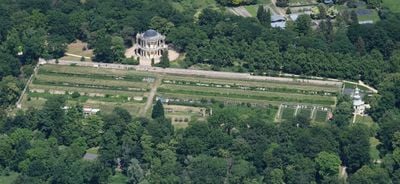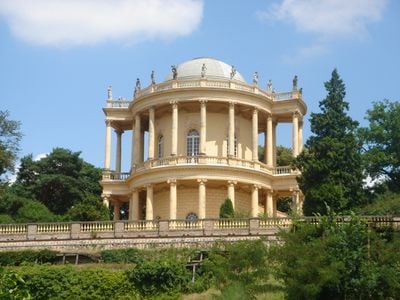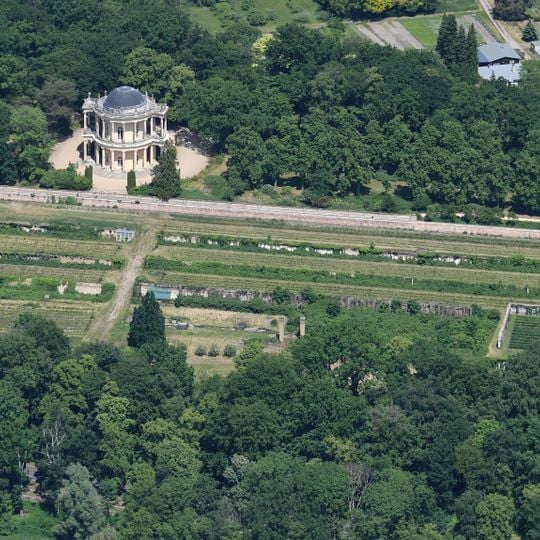
Belvedere on the Klausberg, Observation tower in Sanssouci Park, Potsdam, Germany.
The Belvedere on the Klausberg is a round two-storey pavilion of pale stone built 1770–72, its lower level ringed by twenty Ionic columns and its upper level by twenty Corinthian columns, with balconies to the west and east. A shallow ribbed dome rises above a balustrade carrying twenty sandstone statues of classical deities. Eight arched French doors light the two round halls, one above the other.
The building was designed and constructed between 1770 and 1772 during the reign of Frederick the Great by architect Georg Christian Unger. It suffered severe damage in 1945 but was later restored.
The name comes from the Italian belvedere, "beautiful view", matching its role as a lookout over park, city and countryside. The twenty sandstone statues of classical deities on the dome balustrade were made in several sculptors' workshops; between 1990 and 1994 some were replaced by copies.
Access is available from May through October, typically Tuesday to Sunday, with visitors permitted to enter until 30 minutes before closing at 18:00. Its location at the highest point of the park means the climb on foot is required.
The design was not an original invention: Unger worked from a 1738 reconstruction of the Palatine imperial palace by the archaeologist Francesco Bianchini, who relied on ancient writers, ruins and a coin from Nero's macellum magnum showing a round colonnaded building with a vaulted roof.
The community of curious travelers
AroundUs brings together thousands of curated places, local tips, and hidden gems, enriched daily by 92,852 contributors worldwide.