Chinese House, Garden tea house in Park Sanssouci, Potsdam, Germany
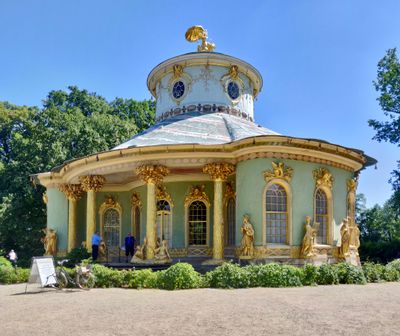
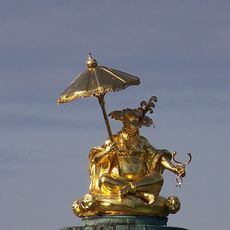
The Chinese House is a trefoil-shaped garden pavilion in Sanssouci Park, with a round central chamber and three cabinets set between open spaces. Its curved tent-like copper roof rests on four gilded sandstone palm columns carved by Johann Melchior Kambly, and a gilded figure holding an open parasol crowns the cupola. Gilded sandstone figures made in the workshops of Johann Gottlieb Heymüller and Johann Peter Benckert sit at the column bases and stand against the walls.
King Frederick the Great commissioned architect Johann Gottfried Büring to build this pavilion between 1755 and 1764, though construction paused during the Seven Years War. The structure was completed following Büring's original design after the conflict ended.
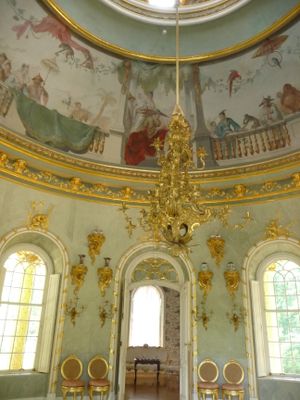
Frederick the Great called it "his monkey house": the gilded stucco monkeys with spectacles and musical instruments over the French windows parody contemporaries who copied Chinese culture without understanding it. The ceiling painting by Thomas Huber (1756) shows Oriental men behind a balustrade, and a large macaw in the cupola strikes the pose of the Prussian eagle.
The pavilion is open from May to October, Tuesday through Sunday between 10:00 and 18:00, with final entry permitted 30 minutes before closing. It is located within Park Sanssouci and reached by walking through the garden paths.
Frederick the Great called the pavilion "his monkey house": gilded monkeys with spectacles and musical instruments sit above the French windows inside, and a large macaw in the cupola strikes the pose of the Prussian eagle. The figures parody contemporaries who copied Chinese culture without understanding it.
The community of curious travelers
AroundUs brings together thousands of curated places, local tips, and hidden gems, enriched daily by 93,095 contributors worldwide.