Villa Liegnitz, Administrative building in Sanssouci Park, Potsdam, Germany
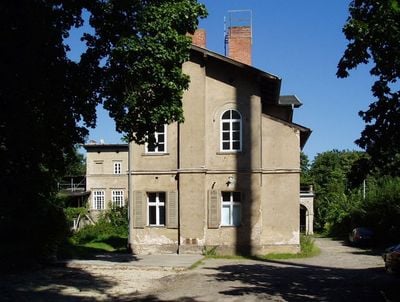
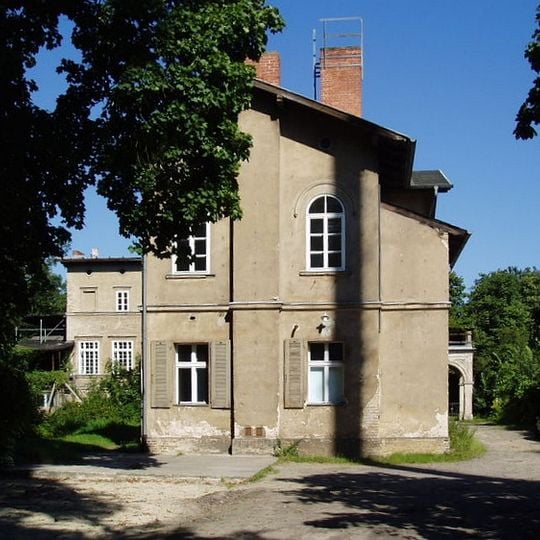
Villa Liegnitz is a two-storey building with a pale greyish-tan rendered facade, standing at the corner of a gravel area at the edge of Sanssouci Park. Its front wing rises to a flat roof topped by a brick chimney, while a lower wing extends to the left. Horizontal bands and a vertical moulded strip divide the facade; four white-framed windows with pale louvred shutters sit in two rows, the upper-right one set in a round-arched recess, with a taller arched window above it.
The villa was built in 1841 by architect Albert Dietrich Schadow for Auguste von Harrach, whom King Friedrich Wilhelm III married in 1824 and made Princess of Liegnitz. She lived there for decades and was allowed to remain after the king's death in 1840. After 1945 it briefly housed a children's home, then from 1950 served as a service building for the Brandenburg State University, whose zoological institute used it until 2004.
The villa's name comes from Auguste von Harrach, whom Friedrich Wilhelm III married in 1824 and titled Princess of Liegnitz; she lived here for decades and died in 1873. From 1950 the Brandenburg State College used it, and its Zoological Institute kept seminar and laboratory rooms here until June 2004, later part of the University of Potsdam.
The building is located in the quiet southeastern area of the park and is easily reached on foot from the main palace. Visitors should be aware that access may be limited depending on current uses, as the Prussian Palaces and Gardens Foundation uses the structure for its research collections.
The 1907 intermediate building with its grand hall and elevated basement is a remarkable example of early 20th-century modifications that transformed the original building layout. This expansion demonstrates how the complex's purpose evolved over time and adapted to new functional needs.
The community of curious travelers
AroundUs brings together thousands of curated places, local tips, and hidden gems, enriched daily by 93,457 contributors worldwide.