Triumphtor, Triumphal gate in northern Potsdam, Germany
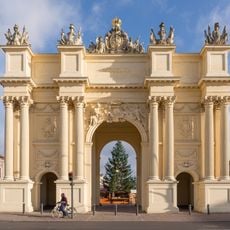
The Triumphtor is a brick and terracotta gate built in 1850–51 at the foot of the Mühlenberg, forming the entrance to the Winzerberg vineyard. It stands at the corner of Schopenhauerstraße and Weinbergstraße in northern Potsdam. Its design by Friedrich August Stüler and Ludwig Ferdinand Hesse follows the Arch of the Argentarii in Rome, with reliefs by Hermann Schievelbein and Gustav Bläser.
Friedrich Wilhelm IV had the gate built in 1850/51 as the intended start of a Triumphstraße linking viewpoints and palaces on the northern edge of Sanssouci Park; only the Orangerieschloss, the Winzerhaus and the gate were realized. The design by Friedrich August Stüler and Ludwig Ferdinand Hesse follows the Arch of the Argentarii at the Forum Boarium in Rome, erected in 204 AD. The king dedicated it to his brother Wilhelm after the suppression of the Baden uprising in 1848.
The gate's name comes from its role as the intended start of a never-built Triumphstraße, a ceremonial road linking viewpoints and palaces north of Sanssouci. An inscription over the passage on the park side states it was built 106 years after Sanssouci's founding, and the vineyard-side inscription honours Wilhelm I for crushing the Baden uprising in 1848.
The monument is located near the northern edge of Sanssouci Park and is accessible by bus and streetcar. Visitors should note that the gate sits in a public area and can be explored on foot without any special requirements.
The two allegorical panels by Friedrich Wilhelm Dankberg on the front show a winged wheel held by a female figure, which became the worldwide symbol of railways, and a figure pointing to telegraph insulators. The winged wheel is said to appear here for the first time as such a symbol.
The community of curious travelers
AroundUs brings together thousands of curated places, local tips, and hidden gems, enriched daily by 93,359 contributors worldwide.