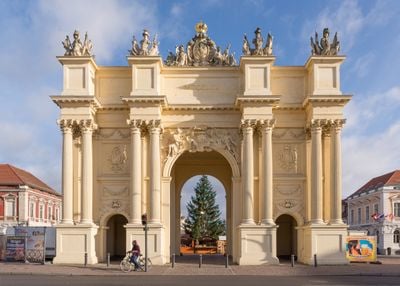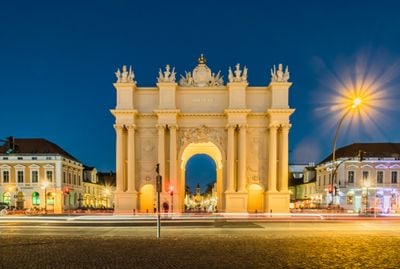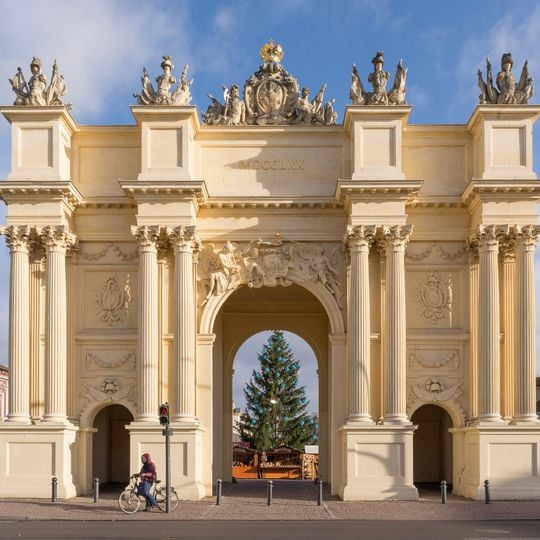
Brandenburg Gate, Triumphal arch at Luisenplatz, Potsdam, Germany.
The Brandenburg Gate in Potsdam is a neoclassical triumphal arch built of pale stone, with a tall central archway and two smaller rectangular pedestrian passages added in 1843. Four fluted Corinthian columns frame the openings, and six statues holding staffs stand on the roofline. The two long sides differ: the city side has a rendered facade with pilasters, while the outer side has projecting column pairs and sculpted reliefs.
The gate was built between 1770 and 1771 by Carl von Gontard and Georg Christian Unger to commemorate Frederick II's victories in the Seven Years' War. The two architects took different approaches: Gontard's inner facade is simpler while Unger's outer side draws from ancient Roman models.
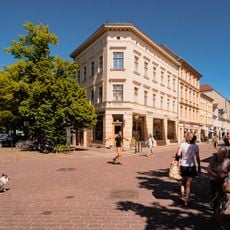
The name comes from the road to the town of Brandenburg, which travellers entered by passing through the gate. Today it opens the pedestrian zone of Brandenburger Straße, running straight east to the Catholic church of St. Peter and Paul. The two pedestrian passages were cut through the side bases in 1843 under Frederick William IV to handle growing foot traffic.
The gate is centrally located in Potsdam and easily reached on foot, with wide side entrances for comfortable passage. Visitors can view it anytime from outside since it stands in public space.
The two faces differ because two architects built them: Carl von Gontard designed the city side with pilasters and trophies, his pupil Georg Christian Unger the country side after the Arch of Constantine, with paired Corinthian columns and golden trumpets. The pedestrian passages in the outer bases were cut only in 1843 under Frederick William IV.
The community of curious travelers
AroundUs brings together thousands of curated places, local tips, and hidden gems, enriched daily by 93,658 contributors worldwide.