Historic Mill of Sanssouci, Windmill in Sanssouci Park, Germany
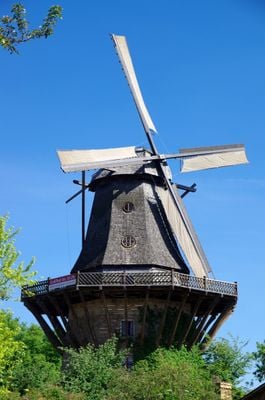
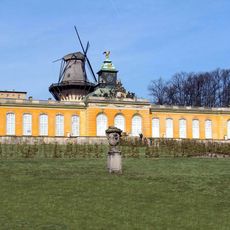
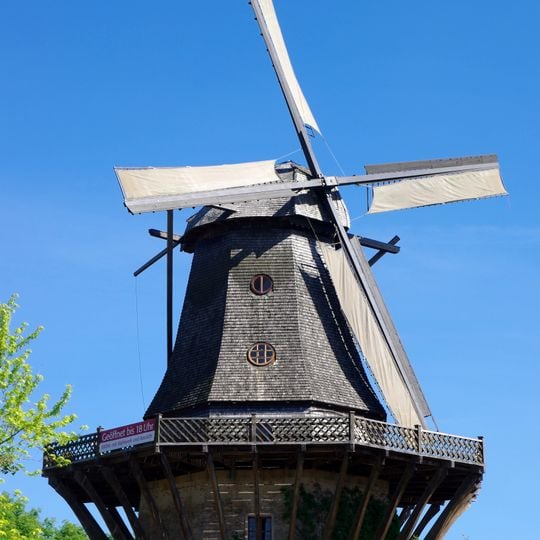
The Historic Mill of Sanssouci is a replica of the Dutch-style smock mill built between 1787 and 1791, standing a few metres west of Sanssouci Palace in Potsdam. Its octagonal stone base, 13.41 metres high, carries a wooden balcony with crossed railings and a dark shingled body rising to a cap with four sails. The mill reaches 25.78 metres to the cap and 35.45 metres to the upper edge of the sails, which are 12 metres long.
A post mill built in 1737–1738 was replaced between 1787 and 1791 by a larger smock mill financed by Frederick William II. On 27 April 1945 the wooden structure burned in fighting; after work on the stone base in the 1980s, the mill was rebuilt from 1991 to 1993 using photographs and foundation measurements, as the original drawings were lost.
The name 'Historic Mill' refers to the legend of the Miller of Sanssouci, recorded by historian Franz Theodor Kugler in 1856: miller Johann William Grävenitz supposedly told Frederick the Great that the Supreme Court in Berlin would protect his mill. In fact, the king valued the mill as an ornament to his palace and granted Grävenitz a second mill site when the first lost wind.
The mill stands a few metres west of Sanssouci Palace, and its stone base, wooden smock and balcony are reached on foot through the park. Signs on the balcony railing announce opening until 18:00 and a museum with souvenirs. The mill is run by the Berlin-Brandenburg Mill Association, which has operated it since 1995.
The present mill is a replica: Cornelius Wilhelm van der Bosch's construction drawings were lost, so the 1991–1993 rebuild was planned from photographs and measurements of the old foundations. A copy of the mill also stands in the Gifhorn Mill Museum.
The community of curious travelers
AroundUs brings together thousands of curated places, local tips, and hidden gems, enriched daily by 93,273 contributors worldwide.