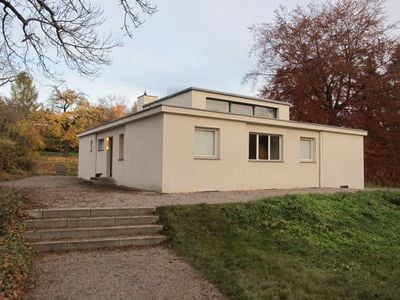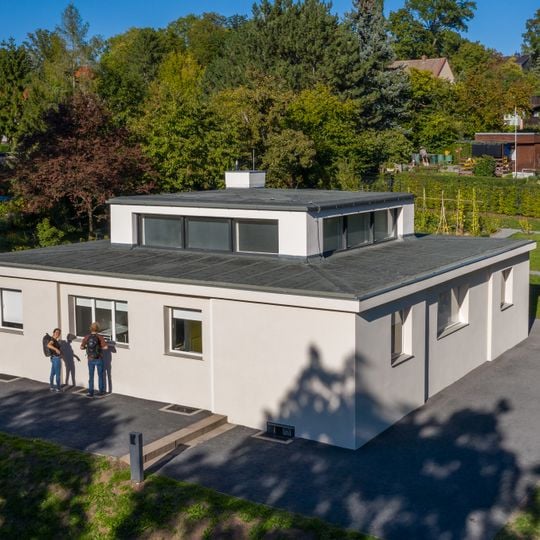
Haus am Horn, Bauhaus design museum in Weimar, Germany.
Haus am Horn is a cubic, flat-roofed house at 61 Am Horn in Weimar, built in 1923 to Georg Muche's design. Its walls combine an outer concrete layer, an insulating layer of peat-based Torfoleum and an inner lining. A raised square clerestory with a continuous band of windows lights the central living room, around which the other rooms are grouped; only the living room's work niche faces outside directly.
Georg Muche's design won a school ballot on 6 October 1922 and was built in four months for the Bauhaus exhibition of July to September 1923, overseen by Adolf Meyer. An interest-free loan from Berlin developer Adolf Sommerfeld financed it, and after the show the house and its contents became his property. A lawyer, Franz Kühn, bought it in 1924 and had Ernst Flemming add a veranda and extensions between 1926 and 1933.
The house embodies Bauhaus philosophy through functional furniture and open spatial concepts that were meant to rethink daily living. The interior displays how designers and craftspeople from the school worked together to create homes that could be both straightforward and effective at the same time.
The space is open to visitors and you can view the room layout and original furnishings in person. It is worth taking time to explore all areas and understand how each space was designed to function.
The walls are built in three layers: an outer concrete wall, an insulating layer of a peat-based material called Torfoleum, and the interior lining. The kitchen by Benita Koch-Otte, with ceramics by Theodor Bogler labelled for their contents, inspired Margarete Schütte-Lihotzky's Frankfurt kitchen of 1926.
The community of curious travelers
AroundUs brings together thousands of curated places, local tips, and hidden gems, enriched daily by 92,820 contributors worldwide.