Borkenhäuschen, Architectural hut in Park an der Ilm, Germany.
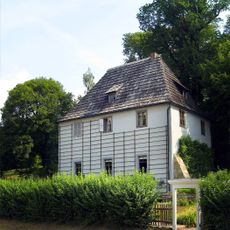
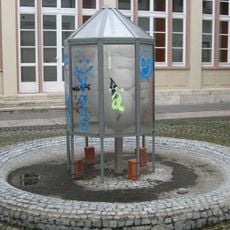
The Borkenhäuschen is a small oval hut on the slope of the left bank of the Ilm in Park an der Ilm, Weimar. Its wooden frame is clad in spruce bark and topped by a conical roof, at times covered with shingles. It stands on an oval stone base and is the only surviving part of the Luisenkloster arrangement.
Goethe had this hut built in 1778 as a gift celebrating the name day of Duchess Luise, marking a shift toward new ideas about nature and retreat. The simple structure represents how park buildings became symbols of enlightened thinking during this period.
The hut was part of the "Luisenkloster" arrangement Goethe had built for Duchess Luise's name day in 1778, and it served as a hermitage for Duke Carl August. Georg Melchior Kraus drew it in 1788 under the title "An der Klause"; the hut later stored theatre props and costumes.
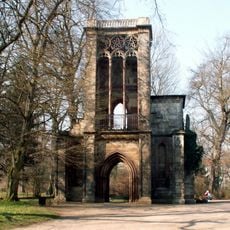
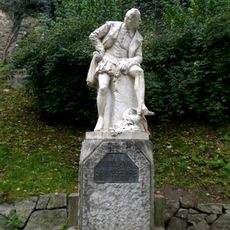
The hut stands on a stone oval base on the slope of the left Ilm bank, not on flat ground, so the approach involves a gradient. It is a few steps from the Shakespeare monument by Otto Lessing and the artificial ruin. The 1960 reconstruction restored its original oval plan.
The hut is a rare surviving piece of the Luisenkloster, a theatre set Goethe had built in 1778 for Duchess Luise's name day. It later stored props and costumes, and the 1960 reconstruction restored its original oval plan. Nearby stand the Shakespeare monument by Otto Lessing and an artificial ruin.
The community of curious travelers
AroundUs brings together thousands of curated places, local tips, and hidden gems, enriched daily by 94,087 contributors worldwide.