Krottenkopf, Mountain summit in Ester Mountains, Bavaria, Germany
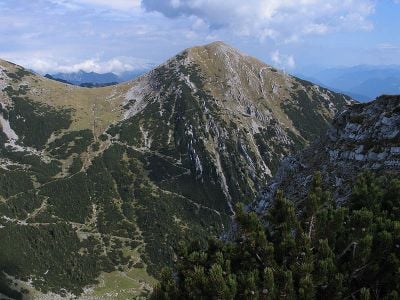
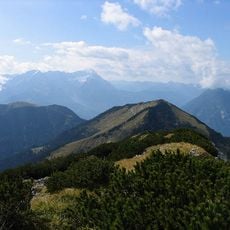
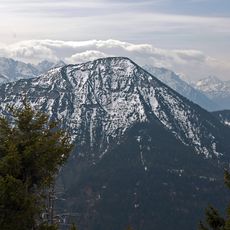
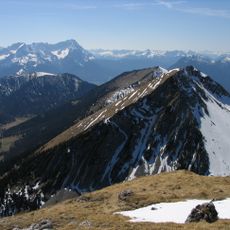
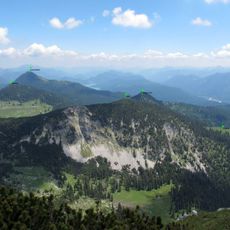
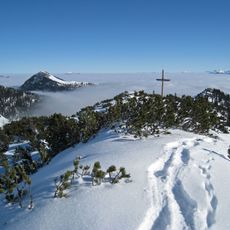
Krottenkopf is a mountain summit in the Ester Mountains of Bavaria that rises to about 2,086 meters. The peak is composed of Oberrät limestone at the top with Main Dolomite forming much of the lower structure, creating the mountain's distinctive geological layers.
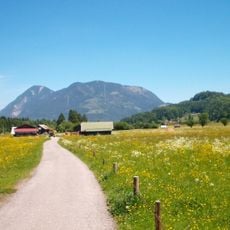
The Krottenkopf's name history is uncertain: one theory links it to the surname Krott, another to mountain toads (Krotten in dialect) once said to live below the peak, and a third to old words Grott, Grutt or Krutt meaning scree or stony ground. Locals note neither toads nor much scree occur there, and no Krott family appears in records. A more plausible explanation is the silhouette: seen from the Isar valley between Mittenwald and Krün, the southern summit resembles a crouching toad, Krout'n in Krüner dialect, while the northern Bischof looks like a bishop's mitre. The two names were probably swapped in the mid-19th century when the Royal Bavarian map system was revised, and the error has persisted.
The origin of the name is uncertain. One theory links it to the dialect word Krotten for toads once said to live below the mountain; another to the surname Krott; a third to old words Grott or Krutt meaning scree. Locals note neither toads nor much scree, and no Krott family appears in records. A likelier explanation is the silhouette: seen from the Isar valley between Mittenwald and Krün, the southern summit resembles a crouching toad, in Krüner dialect a "Krout'n", while the northern one looks like a bishop's mitre. The two peaks were probably swapped during the mid-19th-century revision of the Royal Bavarian map system.
The mountain is accessible from several starting points including Oberau, Klais, and Garmisch-Partenkirchen, with the Weilheimer Hut providing shelter and rest at mid-elevation. Good hiking boots and weather-appropriate clothing are essential, as conditions can change quickly in the mountains.
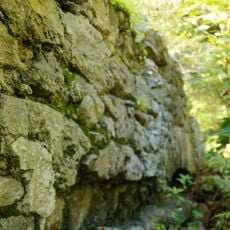
The mountain displays visible layering where the upper limestone differs noticeably from the dolomite formations below, offering hikers a clear view of distinct geological periods. This arrangement serves as a natural lesson in how the Alps were built up over millions of years through different phases of mountain formation.
The community of curious travelers
AroundUs brings together thousands of curated places, local tips, and hidden gems, enriched daily by 93,628 contributors worldwide.