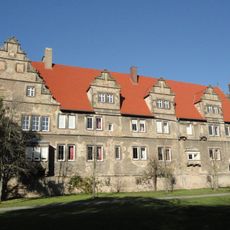
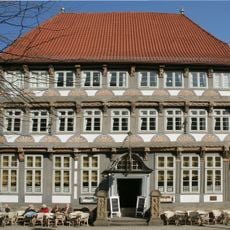
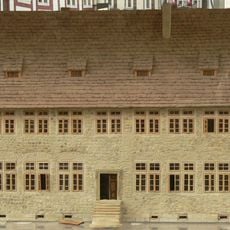
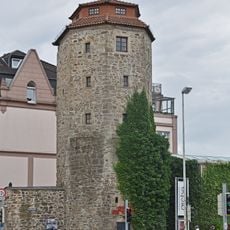
Fischbeck Abbey, Lutheran monastery in Hessisch Oldendorf, Germany
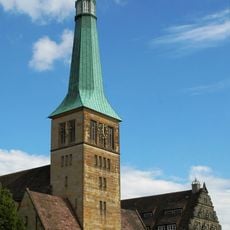
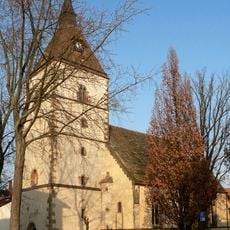
Fischbeck Abbey is an Evangelical-Lutheran convent for canonesses in Fischbeck, near Hessisch Oldendorf. Its church, built mostly in the 12th and 13th centuries, is a flat-roofed cruciform basilica with a westwork and a three-aisled hall crypt from around 1120. The crypt's four clustered columns are carved from single blocks, and the high choir above it sits raised as flood protection.
Founded in 955 by the noblewoman Helmburgis of the Ecbertiner family on land granted by King Otto I, Fischbeck was a canonesses' foundation. In 1147 King Conrad III ordered its transfer to Corvey Abbey, but Pope Eugene III and local lords blocked it; a 1158 papal charter granted exemption from the Bishop of Minden. Around 1260 it became an Augustinian regular canonry, and in 1559 Count Otto IV introduced Lutheran worship, turning it into a Protestant noble women's convent.
The abbey houses a remarkable wall tapestry from 1583 that depicts the foundation story through six detailed panels. Visitors can still see this handcrafted work displayed in its original location within the monastery.
The abbey is located at Im Stift 6a in Hessisch Oldendorf and functions as both a living religious community for Lutheran women and a museum space. Visitors should check in advance which areas are open for viewing and when guided tours may be available.
The abbey church holds a tapestry woven in 1583 showing the foundation in six panels; in the 1950s author Manfred Hausmann was inspired by it to write the play "Der Fischbecker Wandteppich", performed several times in the church.
The community of curious travelers
AroundUs brings together thousands of curated places, local tips, and hidden gems, enriched daily by 93,452 contributors worldwide.