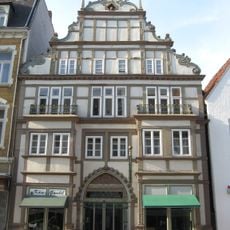
Pied Piper's House, Renaissance building in Hamelin, Germany.
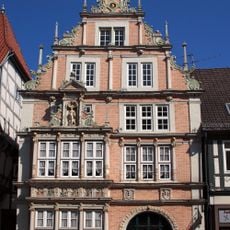
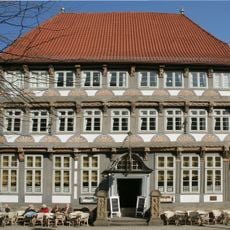
The Pied Piper's House is a Renaissance building from the early 17th century located in the old town of Hamelin, Germany. Its facade features bay windows, carved masks, and stone decorations typical of the Weser Renaissance style found across this region.
The house was built in 1602/1603 by the architects Johann Hundertossen or Eberhard Wilkening for the Hamelin councillor Hermann Arendes. Since 1917 it has been owned by the town of Hamelin. It has been called Rattenfängerhaus only since around 1900, after an inscription on a wooden beam facing Bungelosenstraße that recounts the departure of 130 Hamelin children on 26 June 1284.
The house is closely tied to the town's most famous legend, and visitors passing by can read the inscription on the facade in plain German. Inside, the restaurant keeps the same theme running through its room names and decorations.
The building stands on Osterstrasse, one of the main streets of the old town, and is easy to reach on foot from most central points. Those who want to see the interior can do so by visiting the restaurant inside.
The name Rattenfängerhaus only came into use around 1900, when it was derived from the wooden beam inscription facing Bungelosenstrasse. The text records 130 children born in Hamelin led away on 26 June 1284 by a piper in multicoloured clothes, lost near the Calvary by the Koppen.
The community of curious travelers
AroundUs brings together thousands of curated places, local tips, and hidden gems, enriched daily by 93,646 contributors worldwide.