Fürstenried Palace, Baroque palace in southwest Munich, Germany
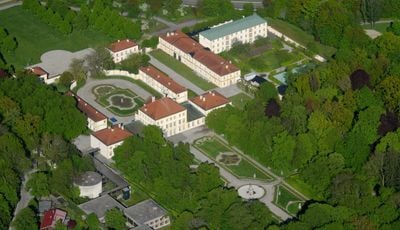
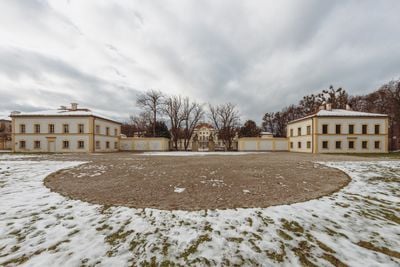
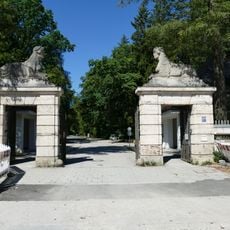
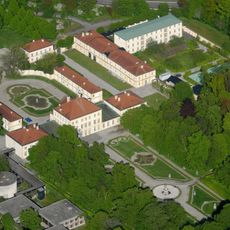
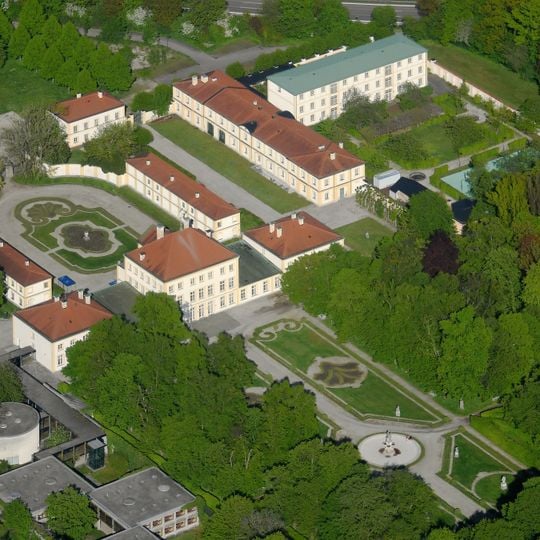
Fürstenried Palace is a Baroque former hunting lodge in southwest Munich, built by Joseph Effner from 1715 to 1717 around a court of honour. A three-storey main building with a small clock tower faces a gravel court entered through a gated entrance between stone posts; two single-storey wings with white banding lead to two-storey pavilions with hipped roofs.
Architect Joseph Effner built the palace between 1715 and 1717 for Elector Max Emanuel, converting what was originally a hunting lodge into a grand residential estate. After completion, it served the Bavarian court as a retreat property outside the city.
Since 1925 the palace has housed the Erzbistum München und Freising's retreat house for spiritual exercises; Jesuit Padre Christoph Kentrup has led it since 2013. The grounds are closed to the public except during events and on the Tag der offenen Tür, so the retreat use, not sightseeing, governs access.
The palace and park are not open to the public except during events and on the open day; the retreat house is not a sightseeing venue. The complex lies in the Thalkirchen-Obersendling-Forstenried-Fürstenried-Solln district, and a roughly 1,000-metre lime-lined sight axis still runs toward the main building.
Joseph Effner's garden was reconstructed in King Otto's time by Carl von Effner, following plans by his ancestor Joseph. Carl von Effner kept 110 lime trees in the park and many more along the two double-row alleys flanking the sight line toward Munich. The palace is not open to the public except on open days and for events.
The community of curious travelers
AroundUs brings together thousands of curated places, local tips, and hidden gems, enriched daily by 92,839 contributors worldwide.