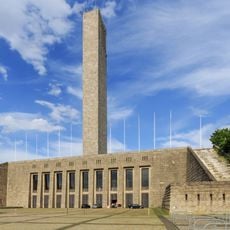
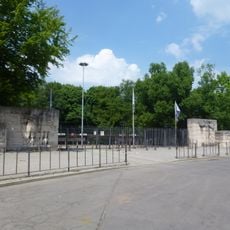
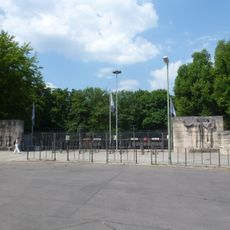
Waldbühne, Open-air theater in Charlottenburg-Wilmersdorf, Germany.
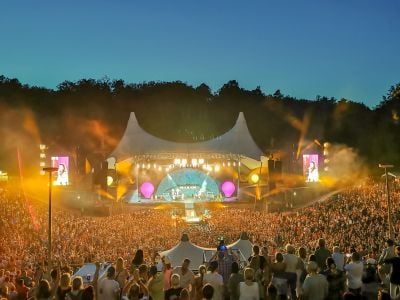
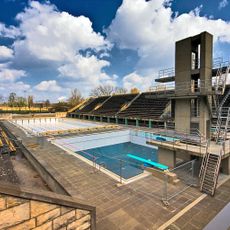
The Waldbühne accommodates approximately 22,000 spectators across three terraced levels built into a natural glacial valley, offering excellent acoustics and unobstructed views from every seat in this forest theater setting.
Built 1934–36 as the Dietrich-Eckart-Freilichtbühne, a Nazi Thingplatz designed by Werner March on a natural ravine and opened on 2 August 1936, the day after the Berlin Olympics began, with Möller's Frankenburger Würfelspiel. It hosted Olympic boxing and Handel's Hercules, and in 1939 a production of Wagner's Rienzi co-designed by Hitler. Renamed Waldbühne after the war, it was used for film showings and boxing before becoming a rock venue.
The theater draws inspiration from ancient Greek amphitheaters, particularly the theater of Epidaurus, and today hosts the Berlin Philharmonic's summer season alongside international rock concerts and classical music performances throughout the year.
Located within Berlin's Olympic Park, the venue is easily accessible by public transportation with nearby metro and bus connections, and transforms into an outdoor cinema during holiday seasons for film screenings under the stars.
The seating rises 30 metres across three ranks; the last row, the 88th, lies 93.5 metres from the centre of the orchestra pit. Because of that distance, 40 microphones were originally installed on stage, feeding 10 coordinated groups of loudspeakers. The stage canopy added in 1982 cost 200,000 euros.
The community of curious travelers
AroundUs brings together thousands of curated places, local tips, and hidden gems, enriched daily by 93,717 contributors worldwide.