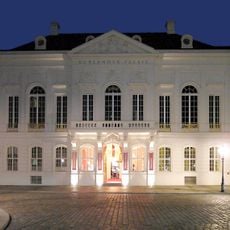
Albertinum, Art museum on Brühl's Terrace, Dresden, Germany
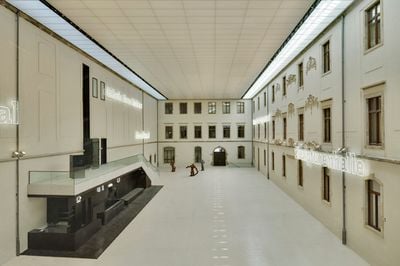
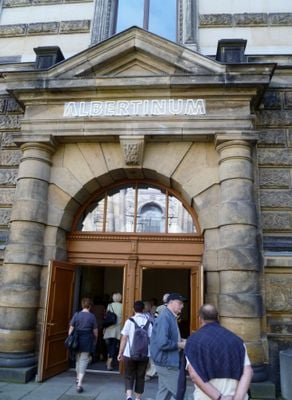
The Albertinum is a sandstone-clad Renaissance Revival museum on Brühl's Terrace in Dresden. Its round-arched entrance bears the name in white outline letters, framed by stacked stone columns and a carved keystone above tall wooden doors. Inside, a steel truss roof spanning the former courtyard at 17 metres forms a light-filled atrium, with two added floors of about 3,450 m² for depots and workshops.
The Albertinum grew out of an armoury built between 1559 and 1563 under Elector August to designs by Caspar Vogt von Wierandt, one of Europe's largest arsenals. After a new arsenal opened in the Albertstadt in 1877, the Saxon Landtag decided in 1884 to house the sculpture collection and the main state archive here. Oberlandbaumeister Carl Adolph Canzler rebuilt it with sandstone facades modelled on the Italian High Renaissance; the building, finished in 1889, was named after King Albert (reigned 1873–1902). Bombing on 13 February 1945 burned out the second upper floor, the roof, the main staircase and the light court.
The Albertinum is named after King Albert of Saxony, who reigned from 1873 to 1902, not after a founder. Its galleries opened in 1891 and 1894, and since 1965 the upper rooms have housed the Galerie Neue Meister. The collection is arranged chronologically from Caspar David Friedrich to Gerhard Richter.
The museum sits on Brühl's Terrace and is easy to reach by public transport. Visitors can access all areas with wheelchairs and find parking nearby.
The building has glass panels that allow visitors to look into storage areas and workshops where artworks are kept and maintained. This offers a rare glimpse into how a major museum operates behind the scenes.
The community of curious travelers
AroundUs brings together thousands of curated places, local tips, and hidden gems, enriched daily by 94,188 contributors worldwide.