Kurländer Palais, Cultural heritage monument in Dresden, Germany.
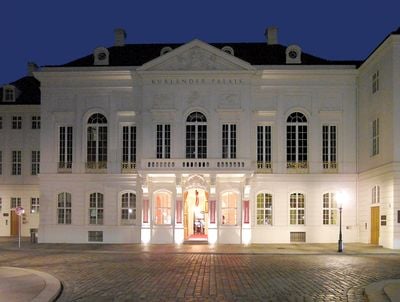
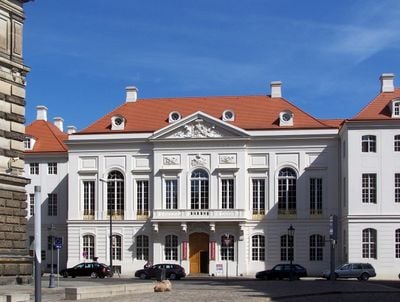
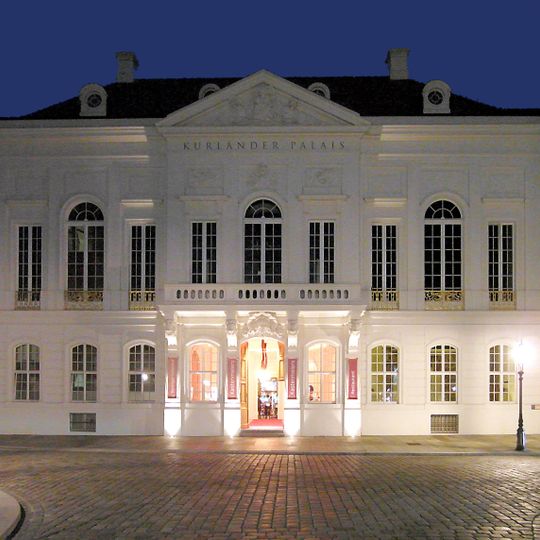
Kurländer Palais is a three-storey Rococo building at Tzschirnerplatz 3–5 in Dresden's Innere Altstadt. Its white street facade of nine window axes is divided by pilasters, with a three-window central risalit crowned by a triangular pediment bearing trophy ornament and a balcony on carved corbels. The ground floor has segment-arched windows with rusticated quoins; the upper floor's windows reach the floor, six rectangular and three round-arched. A hipped mansard roof with dormers sits above, and the northern side wing is set back because the city wall once ran directly east of the plot.
A one-storey building from around 1575 stood here and burned down on 17–18 January 1728, during a visit by Prussian king Frederick William I. Johann Christoph Knöffel then built the palace in 1728–29 for Count August Christoph von Wackerbarth. Prussian bombardment destroyed it in 1760; Friedrich August Krubsacius rebuilt it in 1763–64. In 1773 Charles Christian, former Duke of Courland and Semigallia, bought it, giving it its name. Bombing in 1945 left only outer walls; the ruin was rebuilt in 2007–08 for about 12 million euros.
The palace takes its name from Karl Christian, who was briefly Duke of Courland and Semigallia and bought the building in 1773. In 1738 Frederick Augustus Rutowski, a son of Augustus the Strong, founded here the lodge Aux trois aigles blancs, the first Masonic lodge in Dresden. Since autumn 2015 the vaulted cellars again house the Jazzclub Tonne, which had played there from 1980 until 1997.
The palace stands at Tzschirnerplatz 3–5, at the eastern edge of the Inner Altstadt between the Carolabrücke bridgehead and Neumarkt; tram lines 3 and 7 stop at Synagoge. A paid surface car park and an underground garage are nearby. The building now holds offices, a conference centre, the Kastenmeiers restaurant and the Jazzclub Tonne in its vaulted cellars, which reopened there in autumn 2015.
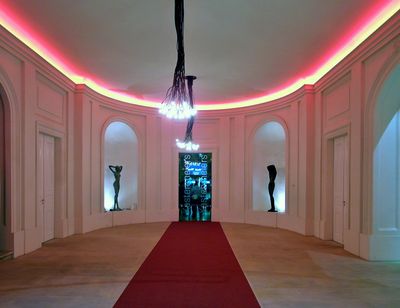
The palace cellars hosted the Jazzclub Tonne from 1980, after a year of conversion work; the club moved out in 1997 when Saxony offered the ruin for sale without guaranteeing cellar access, and returned in autumn 2015. The oval hall seen today, with its pink walls and white dome, belongs to the rebuilt commercial interior.
The community of curious travelers
AroundUs brings together thousands of curated places, local tips, and hidden gems, enriched daily by 93,776 contributors worldwide.