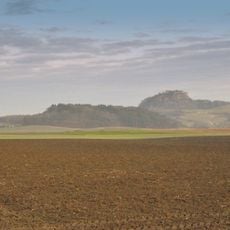
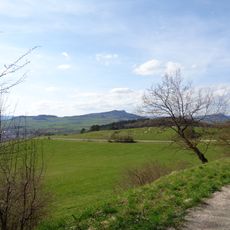
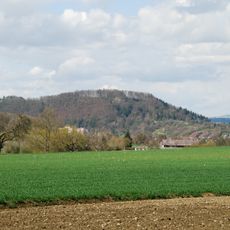
Hohentwiel, Volcanic mountain with castle ruins in Hegau region, Germany.
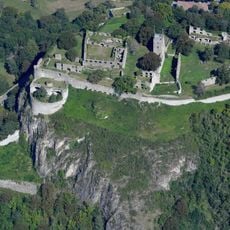
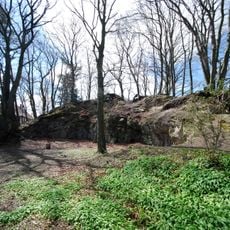
Hohentwiel is a 696.2 m phonolite mountain northwest of Singen in the Hegau region of Baden-Württemberg, Germany. Its flat summit holds the ruins of Hohentwiel fortress: greyish-brown stone walls standing two to three storeys high, low foundations, a round tower on the left and a high wall along the right edge. A separate cluster of ruined buildings clings to the slope below the summit.
The first written record of the castle, as castellum tuiel, comes from Ekkehard IV's St. Gallen chronicle, which reports a siege in 915. In the early 16th century the fortress passed to Württemberg, which expanded it into a state fortress. During the Thirty Years' War it withstood five sieges. It was later razed under Napoleon and soon became a tourist attraction, drawing 86,000 visitors in 2008.
The name was first recorded as "castellum tuiel" in Ekkehard IV's St. Gallen chronicle, referring to a castle besieged in 915; "Hohentwiel" appears in 1521. Its origin is disputed: Melchior Goldast derived it from Latin duellum, Ernst Förstemann rejected this in 1859, and a recent Alemannic root tu- meaning "swell" remains unproven. Since 1988 the northern slope is tunnelled for over 800 metres by the A81 motorway.
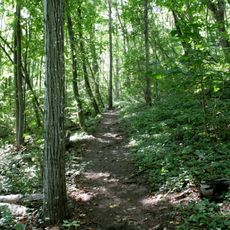
The climb to the fortress ruins takes about 30 to 45 minutes and follows well-maintained paths that become steep in some sections. Comfortable footwear is recommended, as there are many steps and uneven passages to navigate.
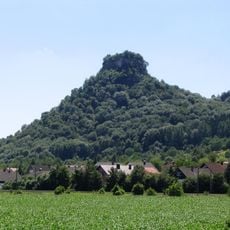
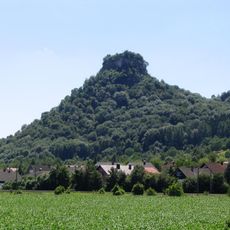
The peak rises like an island from the flat surroundings and is visible from far away on clear days, as the dark phonolite summit towers steeply above Lake Constance and the Alpine foothills. From the top, good weather reveals not only the lake but also several other extinct volcanic cones in the Hegau region.
The community of curious travelers
AroundUs brings together thousands of curated places, local tips, and hidden gems, enriched daily by 93,942 contributors worldwide.