Isenburg Castle, Renaissance castle in Offenbach am Main, Germany
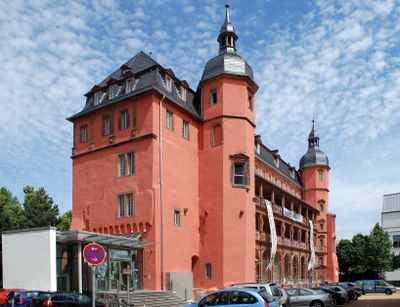
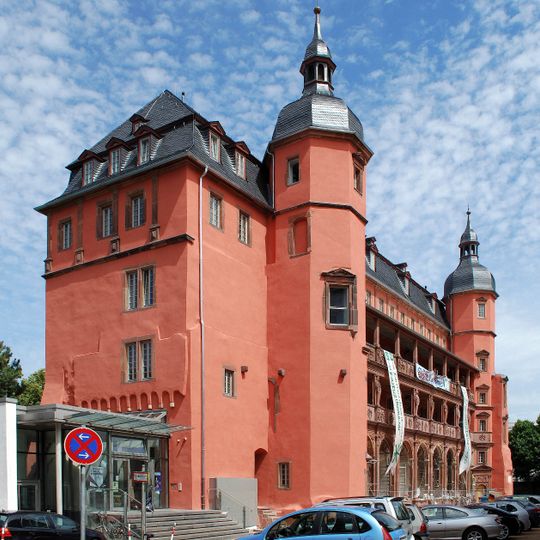
Isenburg Castle is a Renaissance building with salmon-red plastered walls and dark grey slate roofs. Its left main block has a steep hipped roof and three rows of windows, some with white frames; a tall square tower with a slate spire and a smaller turret rise centrally. A long wing with open arcades on the lower levels extends backward to a round tower with a conical roof. Planned as a four-winged castle, it was never completed.
A moated castle built in 1394 by Werner von Falkenstein preceded it; the Renaissance castle was completed in 1559 but burned down completely in 1564 and was rebuilt, giving the south side its arcades. It was the residence of the Counts of Isenburg-Offenbach from 1628 to 1711, and in 1741 a congress on reforming the imperial constitution met here. In 1900 it passed from private ownership to the Grand Duchy of Hesse-Darmstadt.
The name Isenburg comes from the noble family that ruled here for centuries. The two towers on the southern side shape the appearance and remind visitors of the defensive role this place once played.
The building is now home to an art school, which means some areas may not be open to the public. It is advisable to check in advance which parts can be visited and when tours or public events take place.
From 1787 the castle sheltered Jakob Joseph Frank, leader of the Frankist movement, who had been excommunicated in Poland-Lithuania. Prince Wolfgang Ernst II gave him refuge; Frank lived here until his death in 1791 as self-styled Baron of Offenbach, surrounded by some 400 followers. His daughter Eva Frank then kept the house until 1816.
The community of curious travelers
AroundUs brings together thousands of curated places, local tips, and hidden gems, enriched daily by 94,145 contributors worldwide.