Jannowitz Bridge, Prestressed concrete road bridge in Berlin-Mitte, Germany.
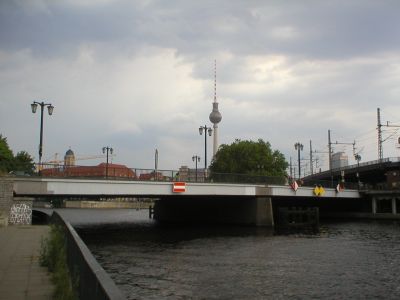
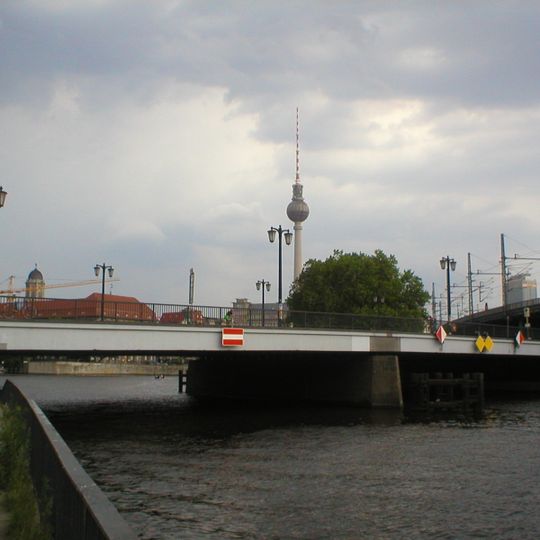
Jannowitz Bridge is a flat steel girder deck bridge over the Spree, carrying Brückenstraße from the southern bank to Alexanderstraße on the north. Its pale deck and railing run straight above dark water, supported by thick rectangular piers; small square signs, including a red-and-white divided sign and yellow-and-black diamonds, are mounted along the railing. The 80-metre span uses the surviving abutments of the 1932 bridge and keeps a clearance of four metres for river traffic.
A wooden bridge funded by cotton manufacturer Christian August Jannowitz opened in 1822 and was named Jannowitzbrücke in 1825. An iron truss bridge replaced it in 1881–1883; that span was dismantled from 1927 for the U8 subway and replaced in 1932 by a steel arch bridge. German troops blew up the 1932 bridge during the Battle of Berlin, and the present steel girder deck bridge was completed in 1954.
The bridge is named after cotton manufacturer Christian August Jannowitz, who founded a joint-stock company in 1821 to finance a wooden bridge over the Spree. The name was approved by King Frederick William III in 1824 and published on 8 May 1825. Until 1840, pedestrians paid a toll of six pfennigs, earning the bridge the nickname "Sechserbrücke".
The crossing is easily accessible on foot or by public transit, with S-Bahn and U-Bahn stations nearby. The bridge accommodates pedestrians, cyclists, and vehicles, all with clear pathways and good signage.
The bridge marks the western boundary of the Mediaspree development area, which runs east to the Elsenbrücke. The U8 subway line crosses the Spree beneath the deck, and an unused connecting tunnel between the U2 and U8 lines passes under the river just west of the bridge.
The community of curious travelers
AroundUs brings together thousands of curated places, local tips, and hidden gems, enriched daily by 94,530 contributors worldwide.