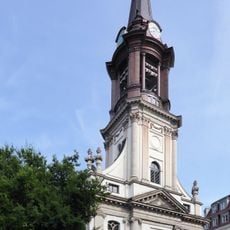
Schicklerhaus, Neoclassical office building in Berlin-Mitte, Germany
The Schicklerhaus is a six-storey neoclassical building erected in 1910 by Hiller & Kuhlmann on a 4,360 m² site, with three main courtyards and four light wells. Its natural-stone façade incorporates a two-storey glass tower on one corner, and the gross floor area is 13,500 m².
The building was erected in 1910 by the architecture firm Hiller & Kuhlmann, originally designed with retail shops on the ground floor and offices on the upper levels. This mixed-use arrangement was typical for Berlin's commercial structures of that era.
The building's name comes from Schicklerstraße, adopted after German reunification for marketing purposes and unrelated to the former Schickler brothers' bank. From 1930 to 1933 the Marxistische Arbeiterschule (MASCH), founded in 1926, used rooms here, where Albert Einstein and Hermann Duncker gave popular-science lectures. A memorial plaque long announced the founding congress of the FSJ on 26/27 October 1918, at which Karl Liebknecht spoke to delegates.
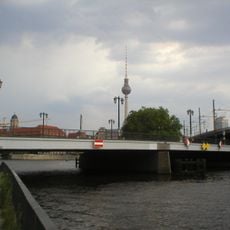
The Schicklerhaus stands in the block bounded by Schicklerstraße, Littenstraße, Voltairestraße and the Stadtbahn viaduct. The U8 station Jannowitzbrücke, the U2 station Klosterstraße and the S-Bahn station Jannowitzbrücke are each a few minutes' walk away, and a bus line stops about 150 metres off. The building is now the BEAM office complex, so the lobby and studios are not open to casual visitors.
From 1930 to 1933 the Marxistische Arbeiterschule (MASCH), founded in 1926, used rooms in the building; Albert Einstein and Hermann Duncker gave popular-science lectures there. A memorial plaque long announced that the founding congress of the FSJ met here on 26–27 October 1918, where Karl Liebknecht addressed the delegates.
The community of curious travelers
AroundUs brings together thousands of curated places, local tips, and hidden gems, enriched daily by 93,897 contributors worldwide.