Prussian National Monument for the Liberation Wars, war monument on Kreuzberg hill, Berlin, Germany
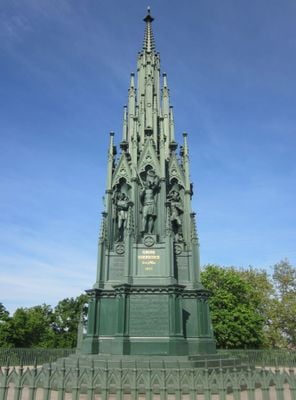
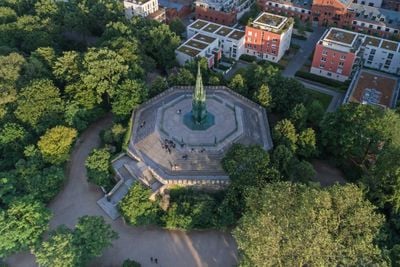
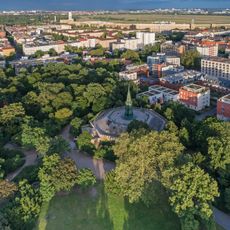
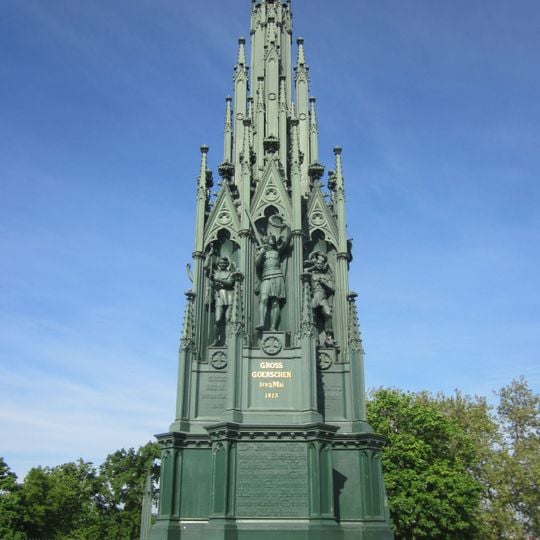
The Prussian National Monument for the Liberation Wars is a cast-iron Gothic spire crowned with an Iron Cross, rising from an octagonal granite platform on the Kreuzberg hill. Its twelve outer sides carry cast-iron genii for battles such as Großgörschen, Leipzig, Paris and Belle-Alliance, and the front bears gold lettering "GROSS GOERSCHEN" with the date 2 May 1813.
King Frederick William III commissioned architect Karl Friedrich Schinkel to build this memorial between 1817 and 1821 to honor Prussian soldiers and citizens. The work was created following the victorious struggles against Napoleonic rule.
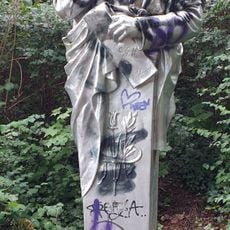
Twelve cast-iron genii stand on the twelve outer sides of the cross-shaped ground plan, each symbolising a battle of the Liberation Wars and bearing the facial features of Prussian generals and members of the royal house. The four projecting figures commemorate Groß-Görschen (2 May 1813), Leipzig (18 October 1813), Paris (30 March 1814) and Belle-Alliance (18 June 1815); with Groß-Görschen the monument also recalls a defeat. The dedication under the Groß-Görschen panel was written by the classical scholar August Boeckh.
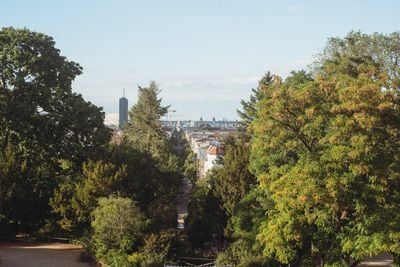
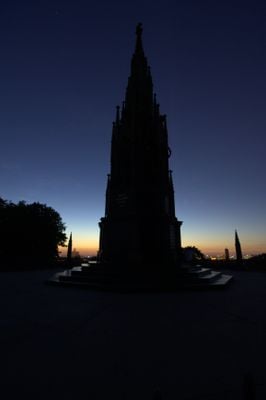
The monument stands on Kreuzberg hill in Viktoriapark and is easily reached from central Berlin. The hilltop is accessible year-round and offers views of the surrounding area.
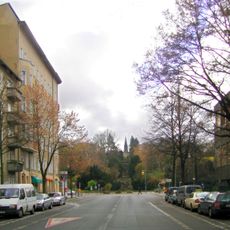
The 1875-1879 lifting was run by engineer Johann Wilhelm Schwedler using twelve hydraulic presses at 30 atmospheres, each with a lifting force of 16 tonnes. The monument was rotated 21 degrees so that it aligned exactly with Grossbeerenstrasse. The new platform, designed by Johann Heinrich Strack, holds vaulted chambers that now shelter a bat colony and a lapidarium.
The community of curious travelers
AroundUs brings together thousands of curated places, local tips, and hidden gems, enriched daily by 92,886 contributors worldwide.