Moritzburg, Cultural heritage monument in Halle, Germany.
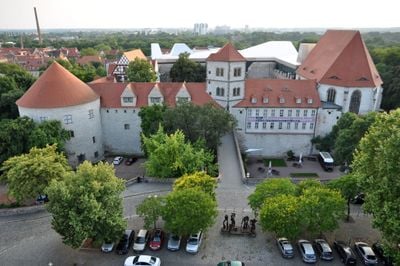
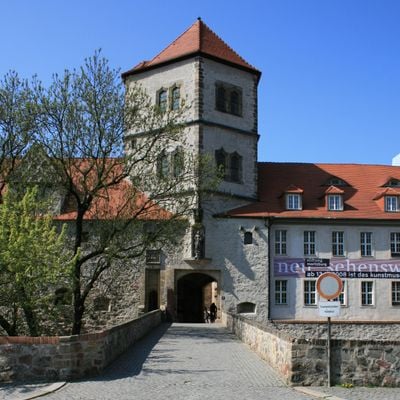
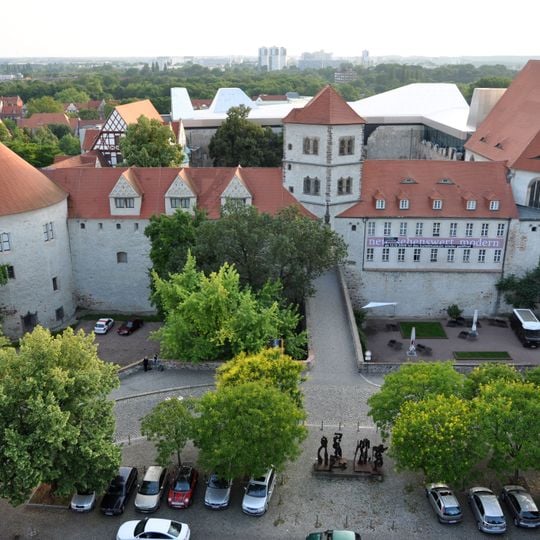
Moritzburg is a four-winged castle begun in 1484 for Archbishop Ernest of Magdeburg, built of rough stone around a courtyard roughly 72 by 85 metres. Its late Gothic forms sit with an almost regular plan and level floors, and a square central tower with a steep red pyramidal roof rises above the wings. The west wing, the show façade, held the archbishop's state rooms and one of the earliest staircases set inside the building rather than on its outside.
The fortress was built to serve the Archbishops of Magdeburg as an administrative and residential center. It suffered severe damage from Swedish forces during the Thirty Years' War, permanently altering its structure.
The name Moritzburg honours Saint Maurice, patron saint of the archbishopric. Since 1904 the ruin has held an art museum of national standing; the north and west wings were rebuilt for exhibitions by Enrique Sobejano and Fuensanta Nieto, opening on 13 December 2008. The museum belongs to the Kulturstiftung Sachsen-Anhalt.
The castle is centrally located and easily accessible by public transport, with Halle's old town nearby. The building features accessible entrances and visitors can explore the rooms independently or join guided tours.
The west wing preserves one of the earliest staircases in the German-speaking world that is set inside the building rather than attached to an outer wall. The north wing's original main entrance, walled up in 1616, is still recognisable by its coat-of-arms frieze. From 1894 the north wing held fencing and gymnastics halls used for university sport until 1990.
The community of curious travelers
AroundUs brings together thousands of curated places, local tips, and hidden gems, enriched daily by 92,984 contributors worldwide.