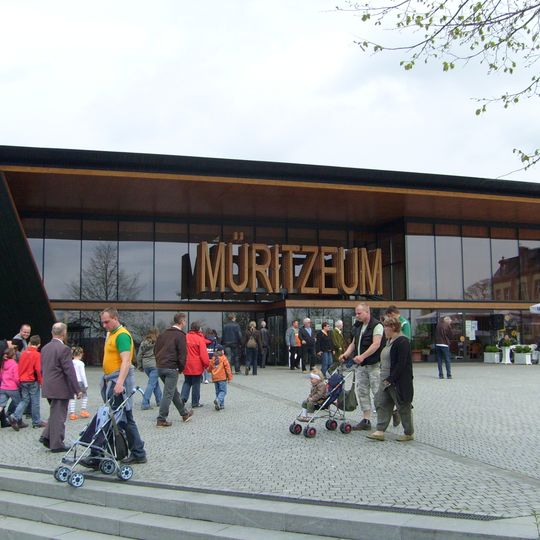
Müritzeum, Natural history museum and public aquarium in Waren, Germany.
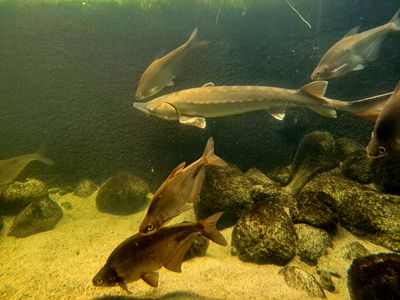
The Müritzeum is a natural history museum and public aquarium in Waren dedicated to regional freshwater life. The exhibition features 25 aquariums housing around 40 native fish species, which together contain approximately 100,000 liters of water.
The institution's origins trace back to 1866 when Hermann von Maltzan established an early natural history collection in Mecklenburg. This initial collection eventually evolved into the present-day facility with its focus on the region's waters and habitats.
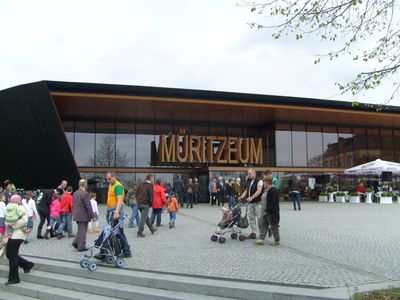
The building's charred larch cladding is a deliberate reference to the region: the architect Gert Wingårdh described two slightly offset cones, cut open by sharp incisions, with the entrance as the deepest cut. The Müritzeum calls itself the "House of a Thousand Lakes", echoing the Mecklenburg Lake District's nickname "Land of a Thousand Lakes".
The complex is split between two buildings joined by a two-hectare museum garden laid out around the Herrensee pond, so allow time to walk between the exhibition halls. The garden holds a roughly 1000-year-old oak, a display beehive and beekeeping exhibits. The entrance front is a glazed wall under a flat roof, with the metal MÜRITZEUM letters mounted above the doors.
The 105,000-litre deep tank holds one school each of the large and small whitefish (Große and Kleine Maräne). In the same building, a sturgeon stream section shows the American Atlantic sturgeon and, since 7 September 2015, the European Atlantic sturgeon, both bred in reintroduction programmes. From 2014 until his death in November 2016, a golden pike from Lake Malchin, coloured by a rare biosynthetic disorder, was kept in a special tank.
The community of curious travelers
AroundUs brings together thousands of curated places, local tips, and hidden gems, enriched daily by 94,231 contributors worldwide.