Stiftskirche St. Servatius, Romanesque church in Quedlinburg, Germany
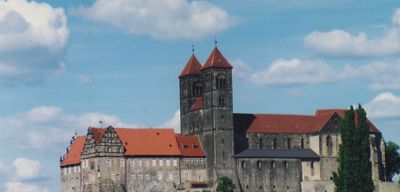
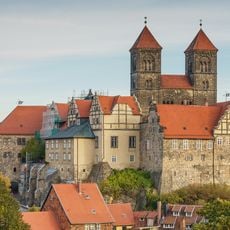
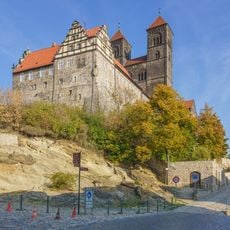
Stiftskirche St. Servatius is a flat-roofed, three-aisled Romanesque basilica on the Schlossberg, built mainly between 1070 and 1129. Its two square west towers carry steep red-tiled pyramidal roofs, the left one slightly lower, and the long nave has a red-tiled gable roof pierced by small arched windows. The interior alternates piers and columns in the Lower Saxon system, with capitals carved with plants, animals and eagles.
Construction of this church began around 1070 and was completed in 1129, following Romanesque architectural principles. It served as the religious center of a collegiate foundation and is closely tied to Quedlinburg's development as a royal and ecclesiastical residence.
The church is still used by Quedlinburg's Protestant congregation for summer services, while the Catholic community of St. Mathilde celebrates its patronal festival here on 14 March. Since 2009 the crypt has reopened to visitors, limited to 30 people per hour, and in summer the building hosts the Quedlinburg Music Summer concerts.
The church is open Tuesday through Sunday with hours varying by season. Wear comfortable shoes for the climb up to Castle Hill, and check current opening times before your visit to plan accordingly.
The crypt beneath the church holds the remains of King Henry I and his wife Mathilde, making it one of the oldest royal burial sites in the Holy Roman Empire. This burial place connects the church to early medieval European political history.
The community of curious travelers
AroundUs brings together thousands of curated places, local tips, and hidden gems, enriched daily by 93,903 contributors worldwide.