Wolfsburg Castle, Renaissance castle in Wolfsburg, Germany
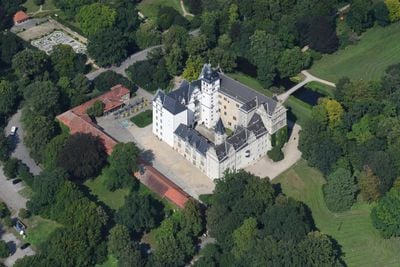
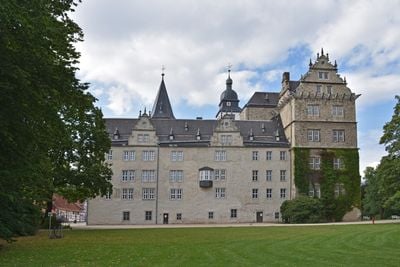
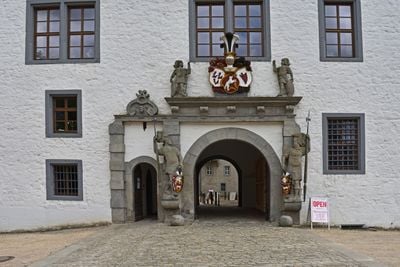
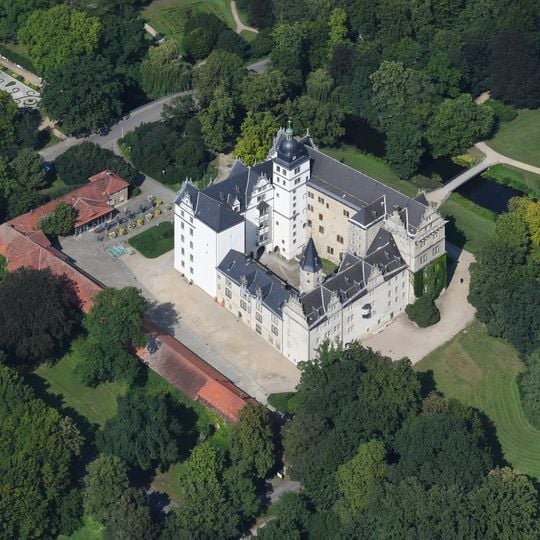
Wolfsburg Castle is a four-winged Renaissance palace around an inner courtyard, with a plain 23-metre bergfried in the west wing, three 16th-century stair towers, and a 25-metre east wing. The entrance has a round arch flanked by over-life-size stone riders, and the park side has a 19th-century terrace with a grand perron.
Originally founded in 1302 as a medieval fortress by the Bartensleben family, the castle received its Renaissance appearance during the 17th century. This transformation from a defensive stronghold to a palatial residence reflects the changing circumstances of the period.
The castle's name comes from the leaping wolf on the coat of arms of the von Bartensleben family, who built it; their line died out in 1742 and the counts of Schulenburg inherited the site. The town founded here in 1938 was first called Stadt des KdF-Wagens and only took the name Wolfsburg on 25 May 1945.
The castle is a four-winged complex around an inner courtyard; the Garden Hall, 30 metres long and 9 metres wide, opens off the east wing, with the adjoining Chamber Room and Gerichtslaube. The bergfried in the west wing, 9 by 9 metres with walls up to 3 metres thick, is recognisable by its lack of windows. The terrace and great perron face the park side.
The name Wolfsburg comes from the leaping wolf on the Bartensleben family coat of arms, with origins tracing back to 1188. This heraldic connection is far older than most other features associated with the location.
The community of curious travelers
AroundUs brings together thousands of curated places, local tips, and hidden gems, enriched daily by 92,883 contributors worldwide.