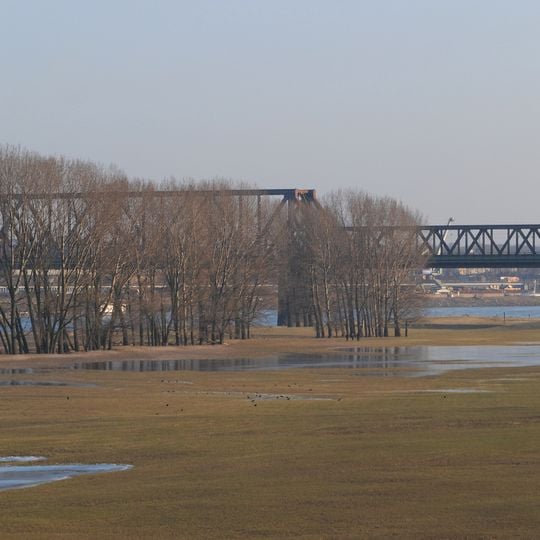
Duisburg-Hochfeld Railway Bridge, Steel railway bridge in Duisburg, Germany
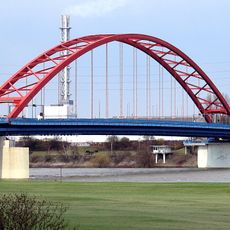
The Duisburg-Hochfeld Railway Bridge carries the Duisburg–Mönchengladbach line over the Rhine between Hochfeld and Rheinhausen. Its main span is a stepped parallel-chord truss (Gerber beam) with spans of 126 and 189 metres, 20 metres above the river. Approach spans of 104 metres and a 51.8-metre span over industrial tracks complete the 907-metre crossing. A pedestrian walkway is attached to the northern side.
The Rhenish Railway Company opened the first bridge on 24 December 1873 for freight, after passenger trains continued to use the Rheinhausen–Hochfeld ferry until 14 January 1874. The 800-metre structure included a 34-metre swing bridge and four 98-metre wrought-iron arch spans. A time bomb exploded on a Belgian military train on 30 June 1923, killing eight. The second bridge opened on 13 October 1927; German troops blew it up on 4 March 1945, and the fourth bridge entered service on 1 October 1949.
The bridge reflects how railways shaped daily life in an industrial city where trains remained central to movement and work. It connects two neighborhoods and shows how transportation infrastructure defined the region's identity.
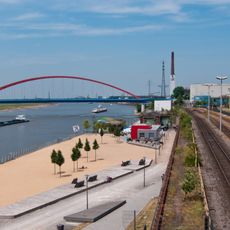
The bridge carries only railway tracks; the pedestrian walkway was attached to the northern side of the 1927 structure, so there is no separate public path across the river here. Views of the truss and the river are had from the banks at Hochfeld and Rheinhausen. The line remains in freight and passenger use, so keep clear of the track area.
During World War II, engineers constructed a temporary replacement bridge in record time to keep the railway operating after bombing destroyed the original. This feat with limited resources shows how vital this transport route was to the region.
The community of curious travelers
AroundUs brings together thousands of curated places, local tips, and hidden gems, enriched daily by 93,548 contributors worldwide.