Homburg Castle, Medieval château in Nümbrecht, Germany
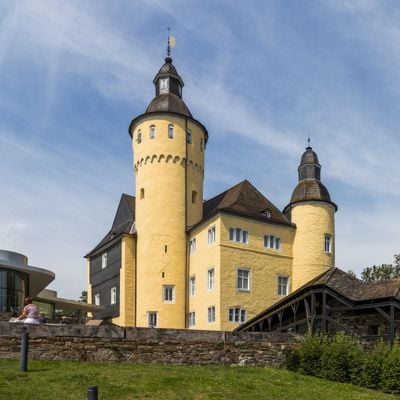
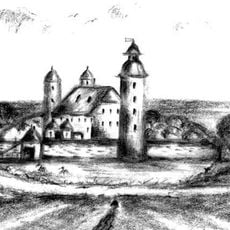
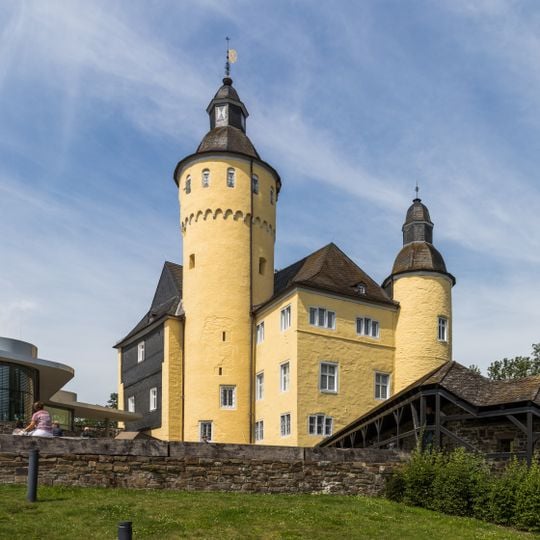
Homburg Castle is a hill castle in Nümbrecht, Oberbergischer Kreis. Its present appearance dates from the rebuilding by Count Ernst von Sayn-Wittgenstein-Homburg from 1635. The complex includes two yellow cylindrical towers: the taller left tower has a dark multi-tiered roof with a clock face and finial, the shorter right tower a dark pointed roof. Between them stands a yellow building with rows of rectangular windows; a dark grey slate-clad wing with steep roof lies to the left, and a low timber-framed structure with tiled roof abuts the yellow wall on the right.
The fortress first appeared in records in 1276 when Gottfried I of Sayn transferred it to German King Rudolf of Habsburg for imperial protection. This transfer established it as an important regional stronghold.
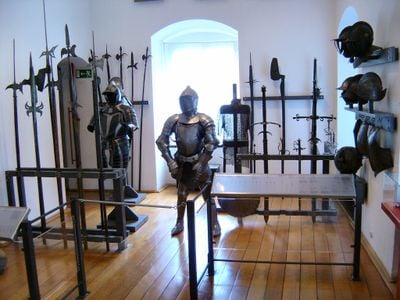
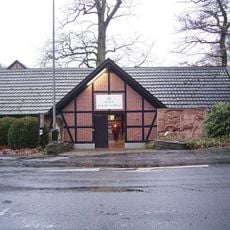
The museum, founded by Hermann Conrad, moved into the castle in 1926 and is now the Museum of the Oberbergischer Kreis. In the former tithe barn, the Rotes Haus, the Oberberg Biological Station runs nature conservation work for the district's reserves. Nearby stand a sawmill and grain mill with a bakery.
The 2.8 km nature trail starts at the castle and runs through Homburg-Bröl and Huppichteroth, past Holstein Mill and the Dicke Steine, back to the castle; nine stations line the route and the walk takes about 1.5 to 2 hours. A sawmill, a grain mill with bakery and the Red House, home of the Oberberg Biological Station, stand close by.
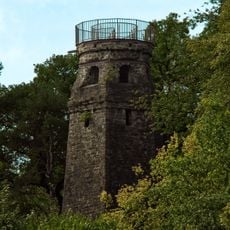
In 1999, excavation on the castle grounds uncovered the remains of a stone residential tower about 12.5 metres in diameter; experts date it to the 11th century, which pushed the site's history back well before its 1276 first mention.
The community of curious travelers
AroundUs brings together thousands of curated places, local tips, and hidden gems, enriched daily by 93,642 contributors worldwide.