Grenzau Castle, Medieval castle in Höhr-Grenzhausen, Germany.
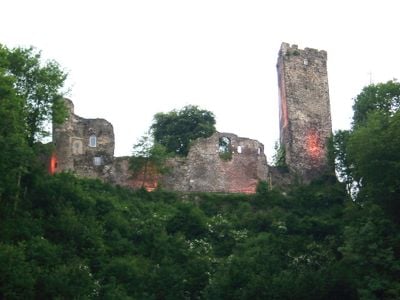
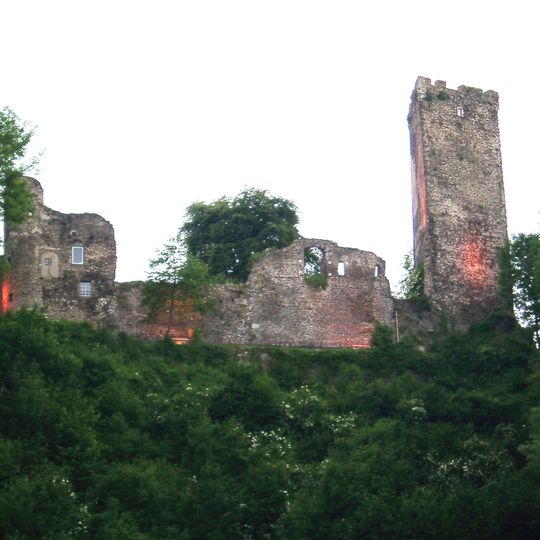
Grenzau Castle is a stone fortress built at about 250 meters elevation and designed with two baileys and multiple defensive rings. The structure includes inner and outer areas that show how medieval defensive fortifications were organized and built.
Henry I of Isenburg built the castle around 1210 as Burg Gransioie, Old French for 'great joy'. A document of 6 January 1213 first records it, noting that the Isenburgs had flouted the rights of Laach Abbey. Archbishop Baldwin of Trier captured it in 1346 during the Grenzau Feud; in 1635 French troops set it on fire, and in 1664 it passed back to the Electorate of Trier.
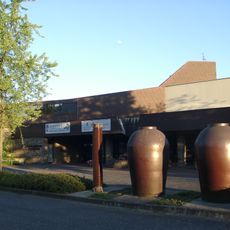
The name Grenzau evolved from the Old French Gransioie ("great joy"), recorded as Gran Joie in 1238 and La Grange in 1525. The castle chapel served the villagers of Grenzau until it was demolished in 1788 and rebuilt elsewhere. Since 1953 the architect Hans Spiegel and his descendants have kept the ruin, and Spiegel housed his collection of Kannenbäckerland pottery here.
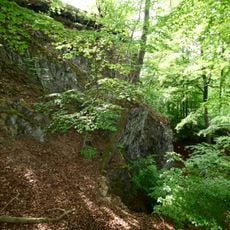
The castle ruin stands on a wooded spur at 250 m above sea level near Höhr-Grenzhausen. Visitors reach the triangular bergfried and the palas ruins on the west side over uneven ground; sturdy shoes help on the slopes and the neck ditches. The site is cared for by a family society founded by the descendants of architect Hans Spiegel, who bought it in 1953.
The triangular keep, 32 metres high and four storeys tall, is the only one of its kind among German castles. Its shape may trace to builder Henry I of Isenburg's link to the Counts of Peilstein, who held estates in Lower Austria and Styria where such forms were common.
The community of curious travelers
AroundUs brings together thousands of curated places, local tips, and hidden gems, enriched daily by 93,593 contributors worldwide.