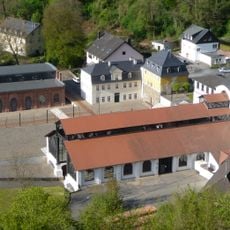
Sayn Abbey, Premonstratensian monastery in Bendorf, Germany
Sayn Abbey is a stone monastery building in Bendorf with medieval architectural features, multiple chapels, and a central courtyard surrounded by cloisters. The complex shows the typical layout of a religious community with spaces for prayer, study, and the daily life of its monks.
Count Henry II of Sayn and his brothers founded the abbey in 1200 beside an existing St Nicholas chapel, and Premonstratensian canons from Steinfeld settled it. The abbey church was consecrated in May 1202 by papal legate Guido of Palestrina; Henry II had died that February. Raised to an independent abbey in 1228, it was dissolved on 12 June 1803 under the Reichsdeputationshauptschluss.
The abbey's pilgrim tradition centred on the arm relic of the Apostle Simon Zelotes, displayed from 1212; a shrine made in Trier around 1220 now stands in the high altar. A chronicle records 22,000 pilgrims gathering on a single Sunday in 1509, and the Simon spring behind the church was credited with healings.
The grounds are located at Abteistrasse 132 in Bendorf and can be reached by regional train from Koblenz. Guided tours of the complex can be arranged in advance, offering a better understanding of the buildings and their history.
The shrine made around 1220 in Trier for the arm relic of the Apostle Simon Zelotes stands today in the high altar; its quality made it one of the best-known reliquaries of the Rhineland. The relic was displayed for veneration from 1212, and the Simon spring behind the church, where it was hidden during wars, was credited with healing power.
The community of curious travelers
AroundUs brings together thousands of curated places, local tips, and hidden gems, enriched daily by 93,785 contributors worldwide.