Burg Löwenstein, Medieval tower in Löwenstein, Germany
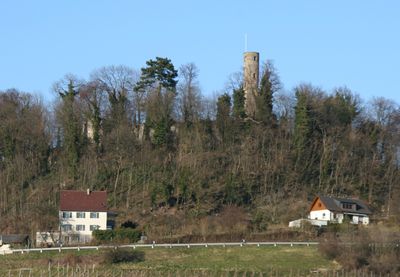
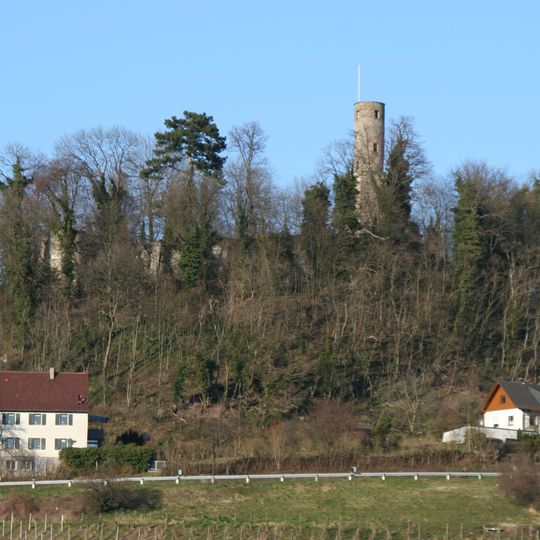
Burg Löwenstein is a ruined spur castle above the town of Löwenstein, built from local sandstone blocks. Its best-preserved structure is the 24-metre stair tower, whose lower part is a rectangular block topped by a slender, roughly three-quarter-round segment. The tower stands on a wooded hill and has small rectangular openings near its top, a flat roof with a low parapet, and a thin pole at its centre.
The castle was built in the late 11th century by the Counts of Calw on a commanding position above the valley. In the late 15th century, new structures were added to the site to adapt it to changes in how fortifications were built and used.
The castle's name comes from the lion, the heraldic animal of the Counts of Calw, who built it, and the name passed to the town below. The counts' line ended, and the site passed to the Habsburgs and later the Electorate of the Palatinate. In 1488 Elector Frederick I gave castle and office to his morganatic son Ludwig of Bavaria, who called himself Count Ludwig I of Löwenstein and founded the House of Löwenstein-Wertheim, which still exists.
The castle is reachable on foot from the center of Löwenstein, with a path that rises gradually through the surrounding landscape. Sturdy footwear is a good idea, as the ground can be uneven or slippery depending on the weather.
Looking closely at the outer walls reveals sections from different building phases, as the stonework was reworked several times over the centuries. This makes the castle an unusual record of how construction techniques changed, readable directly on the surface without needing any specialist knowledge.
The community of curious travelers
AroundUs brings together thousands of curated places, local tips, and hidden gems, enriched daily by 93,981 contributors worldwide.