Burg Elsterberg, Medieval castle ruins in Elsterberg, Germany
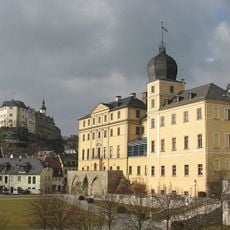
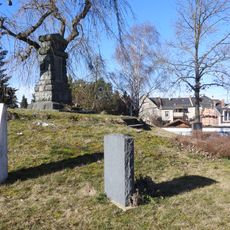
Burg Elsterberg is the largest castle ruin in the Vogtland, lying in a bend of the White Elster at the northern edge of Elsterberg's old town. The Lords of Lobdeburg built it between 1200 and 1225 on a 1.5-hectare site; a double ring wall of considerable thickness and five watchtowers remain, three of them well preserved. The former main building had a vaulted knights' hall with an outdoor staircase, and one of the two surviving round towers holds the Elsterberg local history room.
The Lords of Lobdeburg built the castle between 1200 and 1225 on a 1.5-hectare site, making it one of Saxony's largest fortresses. It was destroyed in the Vogtland War of 1354 and rebuilt by 1366. In 1395 the Margraves of Meissen acquired it, and from 1437 it belonged to the von Bünau family, who sold it with the town to Carol Bose in 1636. Unoccupied after 1698, it decayed until the town of Elsterberg bought it on 25 May 1909 for 13,000 marks.
The renovated cellar vaults host the Heimatfeste, local heritage festivals celebrated since 1883. One of the two surviving round towers holds the Elsterberger Heimatstube, a small local history room. The name Elsterberg appears in the 1349/1350 feudal register of Frederick the Strict as "Hermannus et Hermannus de Elstirberg".
The grounds are accessible year-round and can be visited in most weather conditions. Good footwear is recommended since the ground can be uneven and some areas may become damp.
A deep well was discovered in 1932 that reached far underground. This find reveals how carefully the medieval fortress had been designed to supply water to those living within it.
The community of curious travelers
AroundUs brings together thousands of curated places, local tips, and hidden gems, enriched daily by 93,853 contributors worldwide.