Burg Kallenberg, Castle ruin in Buchheim, Germany
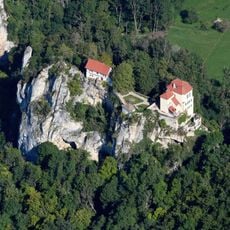
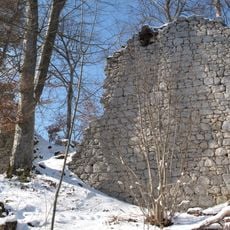
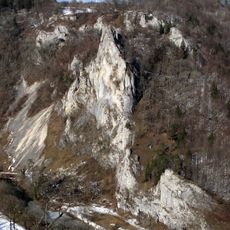
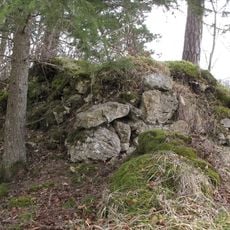
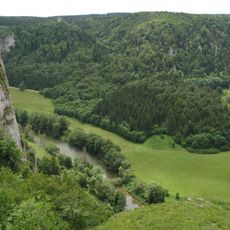
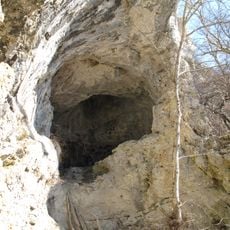
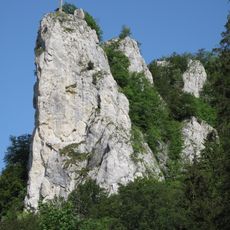
Burg Kallenberg is a ruin on a steep hill at about 776 m above sea level above the Danube, between Fridingen and Beuron. Its keep, a square tower about 8 m wide and 20 m high, is built of carefully cut bossed ashlars and has a high entrance with a three-part shoulder lintel. About 100 m east of the castle lies the Kallenberghöhle, a cave castle with remains of an entrance portal.
The castle was probably built around 1200 and was first named in 1225 after the noble family von Kallenberg. In 1334 it was recorded as property of the Counts of Hohenberg, and in 1381 it was sold to the House of Habsburg. From about 1800 the castle slowly decayed; on 4 March 1905 its farm burned down and was not rebuilt, and on 16 November 1911 the eastern tower gable collapsed in an earthquake. Since 1974 the ruin has belonged to the Tuttlingen district.
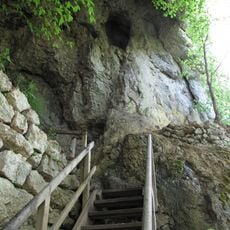
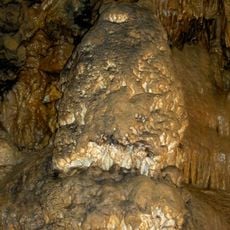
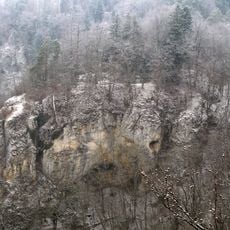
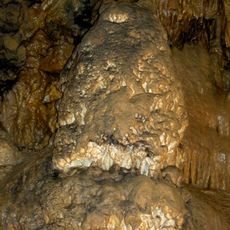
The castle and the Kallenberghöhle about 100 m to the east were used at the same time and form a single ensemble; wall remains of the entrance portal stand in front of the cave mouth. Finds in the cave date to the Celtic period, while the castle itself is presumed to have been built around 1200.
The ruins are reachable from Buchheim via marked hiking trails, and parking is available in the village for visitors. The best time to explore is during good weather, as the path can be steep and the ruins sit on elevated ground.
About 100 metres east of the castle stands the Kallenberghöhle, a cave with the remains of an entrance portal wall. Castle and cave were used at the same time and form one complex; finds in the cave date to the Celtic period, while the castle itself is thought to have been built around 1200.
The community of curious travelers
AroundUs brings together thousands of curated places, local tips, and hidden gems, enriched daily by 92,696 contributors worldwide.