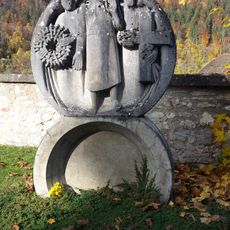
Beuron Archabbey, Archabbey in Beuron, Germany
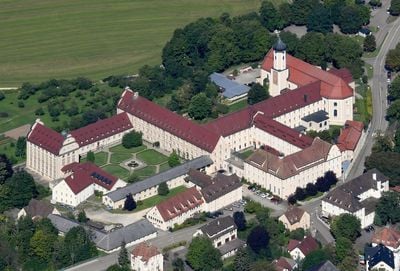
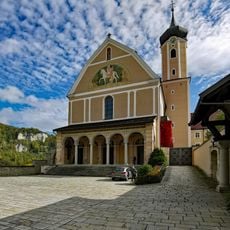
Beuron Archabbey is a Benedictine monastery in the upper Danube valley, founded in 1863 in buildings that had housed an Augustinian canons' monastery from the 11th century until 1803. The abbey church, built 1732–1738 by Matthäus Scharpf, has a high altar by Joseph Anton Feuchtmayer and ceiling frescoes by Joseph Ignaz Weegschaider. The complex includes a library of over 400,000 volumes, cloisters, monks' quarters and a garden with a circular fountain.
The site began in 1080 as an Augustinian monastery and was re-established in 1863 as a Benedictine archabbey under Maurus Wolter following a long period of closure. This revival made the monastery an important center of Benedictine life in German-speaking areas.
The abbey publishes the Missale Romanum, a lay missal first produced by Father Anselm Schott in 1884; the "Schott" remains standard in German parishes. The Vetus-Latina-Institut collects and publishes Old Latin Bible translations. The high altar's Coronation of Mary painting by Gabriel Wüger is swapped each Christmas for a nativity scene, carried over the cemetery and hoisted by pulley.
Guided tours through the church, monastery corridors and outdoor areas are available and provide insight into monastic life and the architecture. Paths within the complex are sometimes steep, so sturdy footwear is recommended.
Here the monks Benedikt Sauter and Dominicus Johner developed their own school for Gregorian chant, which continues to influence German-speaking regions today. Their work helped research old liturgical melodies and revive them for church music.
The community of curious travelers
AroundUs brings together thousands of curated places, local tips, and hidden gems, enriched daily by 94,072 contributors worldwide.