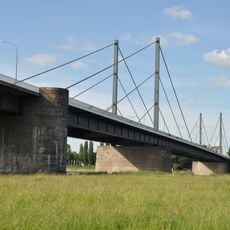
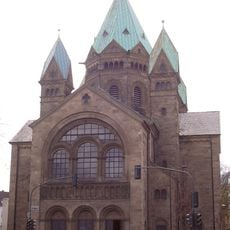
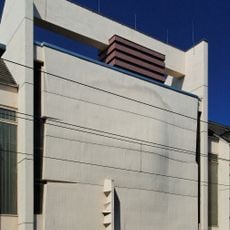
Cecilienallee, Architectural boulevard along Rhine River in Düsseldorf, Germany.
Cecilienallee is a riverside road in Düsseldorf, built from 1906, with buildings only on its east side and the Rheinpark Golzheim along its west. Its southern stretch features freestanding neobaroque administrative buildings, including the Oberlandesgericht and the Bezirksregierung, while the northern part has closed block-edge development from the 1920s and 1930s.
The street was named after Crown Princess Cecilie of Mecklenburg in the early 1900s. It developed following major riverbank construction work undertaken between 1898 and 1902.
The street is named after Cecilie of Mecklenburg, the last German crown princess; her husband, Crown Prince Wilhelm, was patron of the 1902 Düsseldorf trade exhibition held on the avenue's western side. The official inauguration took place on 1 March 1906. From 1936/37 to 1945 the street was renamed "Ufer der Alten Garde", later "Alte-Garde-Ufer", by order of police president Fritz Weitzel.
Cecilienallee runs from north of the Ehrenhof in Pempelfort northwest along the Rhine to Uerdinger Straße, where it becomes Rotterdamer Straße at the Theodor-Heuss-Brücke. The southern stretch to Homberger Straße is part of the B 1, and with the Rheinufertunnel it carries north-south traffic; the Rotterdamer Straße leads on to the trade fair grounds. The western side is parkland throughout.
From 1936/37 to 1945 the street was renamed "Ufer der Alten Garde", later "Alte-Garde-Ufer", after the Nazi Party's pre-1933 members; the Rotterdamer Straße was folded into that name. The order came from police president Fritz Weitzel, based at the Düsseldorf state police headquarters. The name Cecilienallee was restored after the war.
The community of curious travelers
AroundUs brings together thousands of curated places, local tips, and hidden gems, enriched daily by 92,704 contributors worldwide.