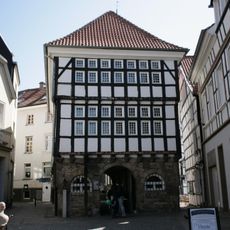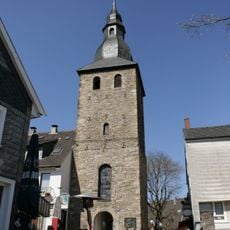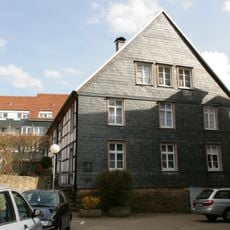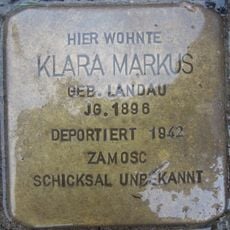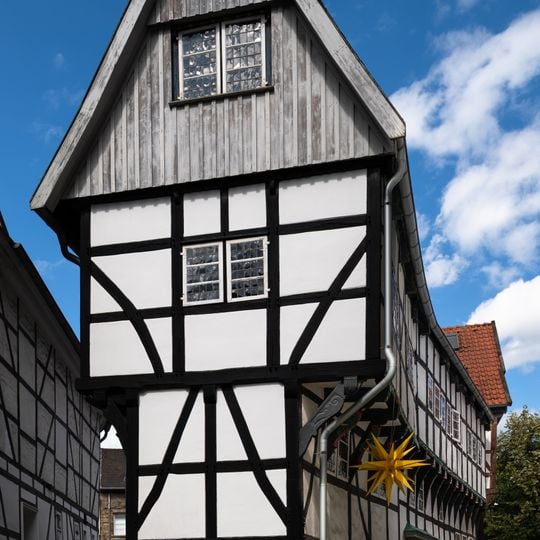
Bügeleisenhaus, Timber-framed heritage building in Hattingen, Germany.
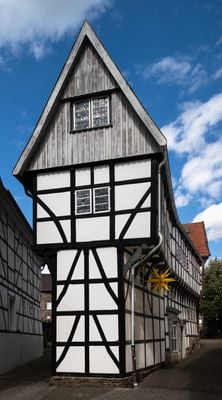
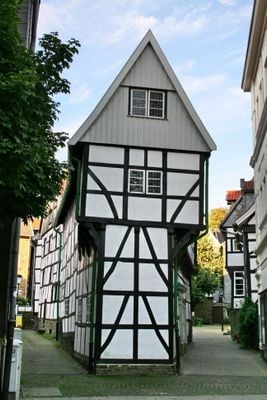
The Bügeleisenhaus is a timber-framed building with an unusual trapezoidal footprint that tapers from the northern side to a narrow southern end. Its facade displays intricately carved wooden beams that give the structure its distinctive character and support the walls.
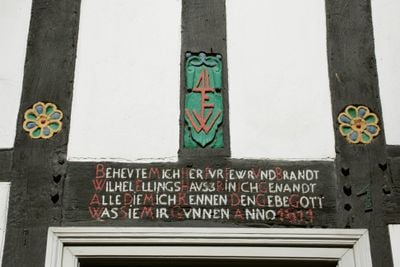
The structure was built in 1611 for merchant Wilhelm Elling and initially served as a residence for the well-to-do. It changed hands in 1853 when Jewish butcher Salomon Schmidt purchased it and carried out substantial renovations.
The carved wooden beams feature masks, ducks, and foliage that demonstrate the craftsmanship traditions of the time. These decorations show how builders once displayed their skill and prosperity through architectural details.
The exterior of the building can be viewed year-round and displays the medieval construction technique to good effect. Visitors should walk around the alley and view the structure from different angles to appreciate its trapezoidal shape and wooden carvings.
The building's name refers to its iron-shaped form, created by its position at the intersection of two medieval alleyways. This geometric constraint from urban planning resulted in an unusually functional and forward-thinking design for its time.
The community of curious travelers
AroundUs brings together thousands of curated places, local tips, and hidden gems, enriched daily by 91,252 contributors worldwide.