Dauner Viadukt, Railway viaduct in Vulkaneifel, Germany.
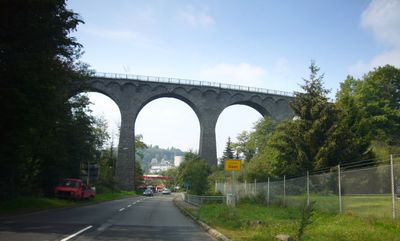
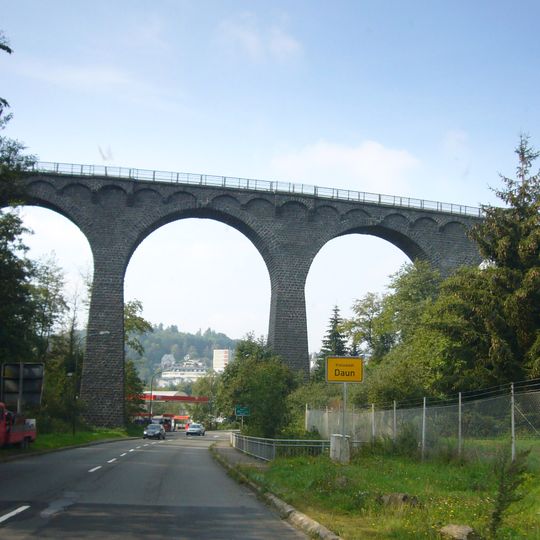
Dauner Viadukt is a five-arch stone railway viaduct 30 metres high and 103 metres long, crossing the Bundesstraße 257 near Daun. Each arch has a span of 16 metres. The single-track bridge was built by the Hochtief company between 1907 and 1909 for 141,000 marks.
The viaduct was built between 1907 and 1909 for the Wengerohr–Daun railway line, with construction carried out by the Hochtief company at a cost of 141,000 marks. Passenger services ended in 1981, freight traffic ceased in 1988, and the tracks were removed in 1990. In August 2000 a cycle path opened on the former line.
Since August 2000 the Maare-Mosel cycle path has run across the viaduct on the former Wengerohr–Daun railway line; the rails themselves were lifted in 1990. Cyclists crossing the 103-metre bridge look down on the town of Daun and the B257 beneath the five stone arches. A model railway museum in Daun, open since 1986, recreates the station and the viaduct in miniature.
The viaduct carries the Maare-Mosel cycle path over the Bundesstraße 257; the route opened in August 2000 after the rails were lifted in 1990. Cyclists cross the 103-metre span at a height of 30 metres, with a view down onto Daun. The bridge is a listed cultural heritage monument.
The five-arch stone viaduct was built by the Hochtief firm for 141,000 Marks, and since 1986 a model railway museum in Daun has displayed a miniature of the station and viaduct. The bridge crosses the B 257 on a 103-metre span at a height of 30 metres.
The community of curious travelers
AroundUs brings together thousands of curated places, local tips, and hidden gems, enriched daily by 93,100 contributors worldwide.